Friday, October 28, 2011

365 Jobs: Afterwards, It's Still There

Diary of a Small Contractor, Days 10, 11, and 12

Wednesday, October 8, 1986

The porch is rotten.  Rusty doorbell button.  A dog barks.  The person opening the door has an undefined body: shirt, blue jeans, short hair — what gender?

“Hello,” I say.  “The owner asked me to look at two small decks.  She said they needed rebuilding.”

“Oh yeah.”  The voice of a young woman.  So, okay.  Female.  “The one you’re standing on.  And another.  Out back.”

She leads me through the living room.  She smokes.  The air stinks.  Massive stereo equipment, stacks of tapes.  A ratty chair.  Rock posters on the walls.  A bookshelf sagging with college texts.  A fine old oak floor covered with scratches and stains, ruined. 

The back porch has termites.  No concrete pad.  Wood in contact with earth.  I take measurements, then return through the stale air of the kitchen and living room.  I measure the front porch, where somebody built a nice pattern into the handrail, though now it’s wobbly. 

The young woman is lifting weights in the living room, taking breaks to puff on a brown cigarette.  Half the books are in German.  Rock music is blasting from the stereo.  In one corner there’s a playpen full of toys.  Otherwise, there's no sign of a child.

The house is a crime.  Absentee landlord.  Careless renters.  At a nearby pay phone, I call Carol, the owner, and tell her that the two porches are well on their way to becoming two piles of termite turd. 

Carol asks, "When can you fix them?"

"I'm booked up for a couple months, but I've got the rest of today.  I could juggle tomorrow, free it up.  Two days would do it."

Carol laughs.  "Somebody told me, if you want to get a job done, call a busy man.  You sound like my guy."

Her reasoning sounds flawed, but I'll take it.  Cash flow, needed.

As I lift off the boards, dismantling the back porch, I start to wonder how far the termites have spread.  I’d better inspect the house to find out where, if ever, the destruction ends.

In the crawlspace I see evidence of termites and evidence of repair.  No active infestation.  The foundation, however, is crumbling away.  Good grief.  As if termites ate the concrete.  The grade beam is turning to powder.  I can pull it off with my fingers — by the handful — like a sandcastle built wet but now dry.  There is practically nothing holding the house up.  If the earthquake chooses this moment to strike, I’m a goner.

Back outside, the almost genderless young woman is straddling a motorcycle.  I ask her to leave the door unlocked for me.

“What for?” she says as she pulls on a helmet.

“So I can use the bathroom.  The telephone.”

She laughs.  “No way,” she says.

Well, shit.  She’s a renter.  She lifts weights and reads books.  There’s a shadowy man who comes and goes in a van and never speaks to me.  There’s another woman living in the garage who ordered me to move my extension cord so it wouldn’t crush her plants.  “They may not look like much to you,” she says, “but they mean a lot to me.”

Actually, I’d admired her plants, especially an oddly shaped purple flower.  I’d intentionally placed my extension cord so as not to hurt the plants, but somebody moved it, perhaps the shadowy man.

I tear the porches out and leave them in a pile in the yard.  Mix and pour two concrete landings.  When I leave, both the front and back doors are three feet above the ground. I could build a temporary step, but I don't.  Take that, motorcycle mama.

At night I call the owner and tell her that before I build porches over the exposed foundation, I should do something to brace it.

To my surprise, she agrees: “Let’s do it right.”  I didn’t expect such an attitude because nothing in that house is right.  She must have recently bought it.  Maybe she doesn’t know what a wreck it is.

"What you really need is to jack up the house and build a whole new foundation.  It'll cost big bucks, though."

"Will you do it?"

"You need a different contractor for this.  I just do small jobs.  Since the house is in Palo Alto, the permit will be a nightmare.  It'll take months.  I can place some piers.  That'll remove the time pressure."

"Do what you can."

Thursday, October 9, 1986

I pull out the old concrete.  By hand.  Amazing.  Whoever mixed this stuff must’ve used the wrong proportions.  Too little Portland cement.  Impure water.  Something.

I mix a fresh batch of Quikrete in a wheelbarrow and pour it.  Then I shove two pier blocks into the puddles of concrete and wedge wood between the piers and the sill.  One corner of the house has already sunk an inch, and I don’t try to jack it up.  At least it won’t sink farther.

Next, I rebuild the front porch.  It goes up fast. 

Two Stanford students are practicing football plays in the street.

The motorcycle mama who wouldn’t unlock the house for me yesterday, today gives me a black cherry seltzer to drink.  On the wall by the telephone is a photo of her and another woman and a baby, all three naked, smiling, in a bathtub.  Definitely not genderless.  I feel like a voyeur.


Two mothers bathing
with one baby.  All look up
smiling at the man.

My hands are eroding.  The fingers crack and peel.  Copper Green, dry Quikrete, they do a job on your skin.  My thumb has a big tender bruise from a misguided hammer.  A nail scratched one knuckle; rebar scraped one wrist.  You can't always wear gloves.  Now I rub my hands with jojoba oil while contemplating the completed front porch.  It’s simple but solid.  Honest, plain, strong.  It’ll outlast the house. 

And that’s one of the reasons I like this kind of work:  afterwards, it’s still there.

Friday, October 10, 1986

This is my third day on a two-day job.  I had to postpone and reschedule; some clients are sore.

Today I'm under time pressure because I have to pick up my son at five o'clock.  On the back porch I cut one board badly but use it anyway leaving a half inch gap where there should be a tight butt joint. 

I load up the twuck with leftover lumber and concrete plus the debris of two porches with the wheelbarrow on top.  Then I pick up Jesse, my son.


With Jesse beside me in the front seat, there's probably a one-ton load in this half-ton pickup.  The truck sways from too much weight.  After four miles on Page Mill Road, greasy smelly smoke starts rising from below the gearshift knob.  It fills the cab.

I open the hood.  A cloud erupts, escapes.  It seems to be coming from underneath the engine instead of the radiator.  No, now it’s coming from the rear sparkplug.  How can steam be coming from a sparkplug?

I fix houses, not engines.  I know enough to use a rag as I open the radiator, but no steam rushes out.  It’s empty.  Bone dry.

Two hundred feet away is a large brick house which looks very rich and very private and very not to be messed with, but bless them they have a hose faucet right by the road, so Jesse and I without asking permission form a bucket brigade filling a Coke bottle and a thermos over and over until the radiator is full.

No water is dripping out.  Hoses tight. 

What happened?  How’d I lose it?

I wince, thinking of the mis-cut board, the half inch gap. 

I drive on.  We fill the Coke bottle and thermos, just in case.  A few miles later, the engine is overheating.  I’m now at the foot of the mountain.  I stop, empty our spare water into the radiator.  I teach Jesse how to open the radiator cap.  Jesse, by the way, is ten years old.  Today is his birthday.


Smoke billowing from
beneath my little truck on
a road leading home.

At the top of the mountain I’m overheating again.  There’s a gas station.  Jesse opens the hood for me.  I try to show him how to set the bar to hold the hood open.

“I know,” he says, and sets it for me.  So far, he's known a lifetime of car trouble.  It's normal for him. 

I re-water, then coast seven miles downhill with the engine off and arrive home with the radiator still cool, still full.

Back home, my wife has left notes all over the house.  A plan has developed: to celebrate Jesse's birthday, my wife and daughter and younger son have hiked to the Sierra Club Hiker's Hut which sits on a mountain ridge in Pescadero Creek Park, not far from where we live.  Jesse and I are to join them there.  We'll spend the night.  Perfect.

I shower and change.  Jesse gathers supplies. 

You can only reach the Hiker’s Hut by hiking.  Jesse and I, wearing backpacks, carrying flashlights, climb through the woods up the side of the ridge starting in a grove of creekside virgin redwoods, rising through oaks.  There’s no moon.  Through a break in the trees I see bright stars.  I say, "There's Cassiopeia."

Jesse walks ahead.

I hear a sudden sound from the dark woods.  I stop, spooked.

Jesse says, "It's a branch falling, Dad." 

Things fall apart.  Even trees.  Half inch gap.

Jesse hikes fast.  I’m getting winded.  My backpack gains weight as I ascend.  I want to protect Jesse from mountain lions in the forest, or at least from falling branches, but I can't quite keep up with him.


With my son climbing
a mountainside at night
toward stars.

The Hiker's Hut is no hut.  It has electricity, a refrigerator, stove, running water, even hot water.  Well-built, nice details.  No half inch gaps. 


Dinner’s over but Jesse and I have spaghetti, garlic bread, salad.  Somehow my wife carried a small cake a mile uphill, only slightly smudged.  Candles.

We lie in sleeping bags on the deck overlooking a meadow on the ridgetop.  Deer settle, making beds in the oat grass.  The stars are magnificent.  The Milky Way oozes across the bowl of sky from the ocean in the southwest to the distant glow of San Francisco, northwest.

A raccoon is rattling logs in the woodpile.

Exactly ten years ago Jesse came into my life and changed everything forever.
 

Next week I'll go back and cut a new board.

Tuesday, October 25, 2011

Lit Night in La Honda

On the last Wednesday of every month, we hold Lit Night in La Honda.  We meet in the bar of the Cafe Cuesta (formerly Sullivan's) for beer, wine, dinner and audience-friendly stuff.  I'll be reading as usual, along with a mix of pro and amateur writers.  Poetry, prose, and the occasional one-person drama.  Y'all come!

Monday, October 17, 2011

More Arno Sternglass

I've talked about Arno Sternglass before.  I show a number of his paintings here and talk about his joy of life here.

Recently I bought a painting of his on eBay.  The seller had salvaged it from a barn sale.  It was mildly water damaged, but now cleaned and framed, it shines like a bright light.


Cafe by Arno Sternglass
The scene is a cafe on Third Avenue in Manhattan where Arno and his wife Lila liked to eat.  In exchange for some meals, Arno made this painting for the owner in 1971.  The owner gave Arno more credit than he had expected.  So — and this is typical Arno and Lila — they decided to celebrate their 15th wedding anniversary at the restaurant and invited 3 couples to join them.  Lila says, "We all enjoyed a fine meal and drank a lot of wine."

The cafe is gone.  Somehow, years later, the painting ended up in a damp box in a barn in New Hampshire where it had been collected — and hoarded — by a blind woman who liked to buy art work at yard sales.  For a blind woman, she had a good eye.

Here's one more painting I didn't include in my previous post.  Some of the color has faded.  It's another playground scene from Central Park in the 1950's:

Playground, Central Park by Arno Sternglass

365 Jobs: Earthquake

October 17, 1989

Today's job was rewiring a house in Menlo Park.  It was grubby crawlspace work creeping on my belly, running Romex, lying on my back hammering staples into joists.  Thinking, always, I'd hate to be down here in an earthquake.

Now I'm swimming laps.  Oddly enough after a hard day's work, there is nothing I enjoy more than swimming myself to utter exhaustion. 

It's 5:04:49 p.m.  Suddenly I'm surging on a wave.  Like in the ocean.  I'm body-surfing.  What the hell? 

I'm swept to the side of the pool.  Waves are breaking over the edge.  Aluminum chairs are dancing and rattling all over the concrete deck.  That was the sound of the quake for me — clattering aluminum chairs.  With water splashing all over the concrete deck, there is a smell like a dusty road after a summer rain.

The pool is at a private club.  My son Will, age 7, comes running to me wearing a baseball glove.  He's been throwing balls on the tennis court.  He says, "What happened?"

"Earthquake," I say.  "You feel it?"

"I fell down."

"I was in the pool," I say.  "Come to think of it, a swimming pool may be just about the safest place you can be in an earthquake.  Nothing can fall on you."

"Can I get in?"

The water level is a few inches below where it was.  The power is out.  Otherwise, everything is normal.  No damage.  What can I say?  When you've lived in California for a long time, you get blasé about earthquakes.  This one didn't seem any different, only bigger.

"Sure," I say.  "Jump in."

And so for the next half hour, I finish my laps while Will dives for pennies.  It would prove to be my last half hour of calm in the next few weeks.

Two boys also jump in the pool — with their clothes on.  Later their mother arrives.  “We fell in,” they say.  "The earthquake made us fall."

“I hope your shoes aren’t in there,” she says. 

“No, we took them off,” they say.  "Then we fell in."

After I shower and change, as I’m getting a cup of coffee, the bartender tells me that a section of the Nimitz Freeway collapsed.

Hmm.

Will and I drive to the Portola Valley Town Center, where my older son Jesse is just finishing soccer practice, which also continued as normal.  A soccer field — like Will on the tennis court and me in the pool — was a safe place to be.  The Town Center sits exactly, literally, right smack dab on top of the San Andreas Fault.  My 12-year-old son had been standing on it.  He said he fell down, then stayed perched on his knees watching waves move through the grass.

None of us have any idea how big the quake was.  But as I drive to pick up my daughter, on the radio we hear that a section of the Bay Bridge collapsed.

In my truck we follow the route of the San Andreas Fault along Portola Road, crossing back and forth over the fault line, then continue on Sand Hill Road to the gymnasium where my daughter has gymnastics.

She's waiting for us in the parking lot.  Everyone else has already been picked up.  Her class had to leave the building because ceiling tiles were falling down, so she’s been waiting outside.  "Where were you?" she asks.  She was bored.

We drive home.  Many radio stations are off he air.  KNBR is on.  They say the Bay Bridge and the Nimitz collapsed and fires are breaking out.

On the way home, a small barn has collapsed.

I stop in front of our house and hear voices and falling brick.  The La Honda Fire Brigade is dismantling our chimney, which was on the verge of collapse.  My wife is holding a flashlight for them.  Our power is out.


The house is a shambles.  Books, records, and cassette tapes all over the living room.  Food and glass all over the kitchen — molasses, peanut butter, vinegar, sugar, wineglasses, heirloom china — all over the floor.  And it’s now dark.  I find flashlights and light lanterns and loan a Coleman lantern to the neighbors.  Their house has a huge hole in the wall where the chimney collapsed.

I inspect our house.  Sheetrock came loose on the walls.  Papers and books flew around but the computer didn’t budge.  The bathroom medicine cabinets burst open.  The sink is full of pills and Band-aids.  The back porch detached itself from the house.

So we start cleaning up.  I bring in a garbage can, and we fill it up.  My daughter tends to her stuffed animals who are traumatized by the quake.  Will and Jesse clean up the living room.  My wife tackles the kitchen.  I reshelve the bathroom supplies.  We mop the kitchen floor several times, and it’s still sticky.  We replant some potted flowers that crashed.

The phone works, but you have to wait for a dial tone.  I call a friend across town whose husband is out of town.  "Are you all right?" I ask.

"I'm fine," she says.  "Don't worry about me."

Several days later I learn that this woman was standing in the rubble of her collapsed fireplace, an entire corner of her house suddenly missing, telling me she's fine and not to worry.  She thought I should help somebody who might really need it.  This attitude of altruism will show up again and again among practically everybody in the days to come.

We listen to the radio a bit, but its tone is basically one of panic — saying, “DON'T PANIC!!!” and giving a lot of foolish and contradictory advice such as, "Stay out of your house!" and then a minute later: "Don’t go outside!"  So we turn it off and deal with the real.

The kids — and the dog — sleep on the floor in our room.  We feel aftershocks all night.  We're together.  We'll get through it.


The next day, we start to rebuild.

As a contractor, the next few months will be the busiest period of my life.  At first I make emergency board-ups and bracings for free.  Then I charge my regular rates.  

The insurance inspector estimates the damage to my house at $11,000.  He warns me: "Watch out for profiteering contractors."

I tell him, "I'm a contractor."

The deductible on my homeowner's policy is $13,000.  I can fix it myself, except I'll get a mason for the brick chimney.

Of all the houses I repair after the quake, I never meet one homeowner who collects a penny from insurance.  I agree: let's beware of profiteering.


Note: I wrote an entire book about that earthquake with a no-nonsense title: QUAKE!  It's a
young adult novel based on true events about people in the town of Loma Prieta, which sits on Loma Prieta Mountain, the epicenter of the quake.  You can get any e-book format from this link to Smashwords, or you can get the epub format from iBooks or the Kindle format from Amazon.  You can get used copies of the print book through places like aLibris or Amazon, or you could get a brand new, signed copy from me.  Send an email if interested: joecot@coastside.net

Thursday, October 13, 2011

What We Do Is Dangerous

October 13, 2011
Photo by Joseph Kral

Construction accidents can happen when you least expect them.

Yesterday on a narrow road in La Honda, a truck from GraniteRock was delivering 9 yards of concrete for the final pour of a house.  As he approached, the construction workers offered to help guide him with hand signals around the last hairpin turn.  The driver waved them off.  He had years of experience and had delivered to this same project on earlier pours. 

Making the turn, the rear wheels went off the pavement onto the soft shoulder of the private road.  The barrel of the truck was still mixing, which may have shifted the load off center.  As the shoulder crumbled, the guard rail collapsed.  The truck slid sideways and backward into the canyon of a creek.  The cab flipped.  The force of 30,000 pounds of concrete falling into a canyon flattened the cab as if it had been put through a crusher.  The driver died immediately.  It took the entire day and into the night before they could get his body out of there.


Photo by Joseph Kral

Fred Eisenstaedt, the driver, was 62 years old.  Everybody liked him.  Sometimes he brought his terrier dog along with him on deliveries.  Not this day.

A day later, the truck body has been removed.  The barrel containing 9 yards of hardening concrete is still in the canyon.


Lawyers and insurance companies will argue over who was at fault.  We in the trades only need to know that a good man is gone.


Be careful out there.

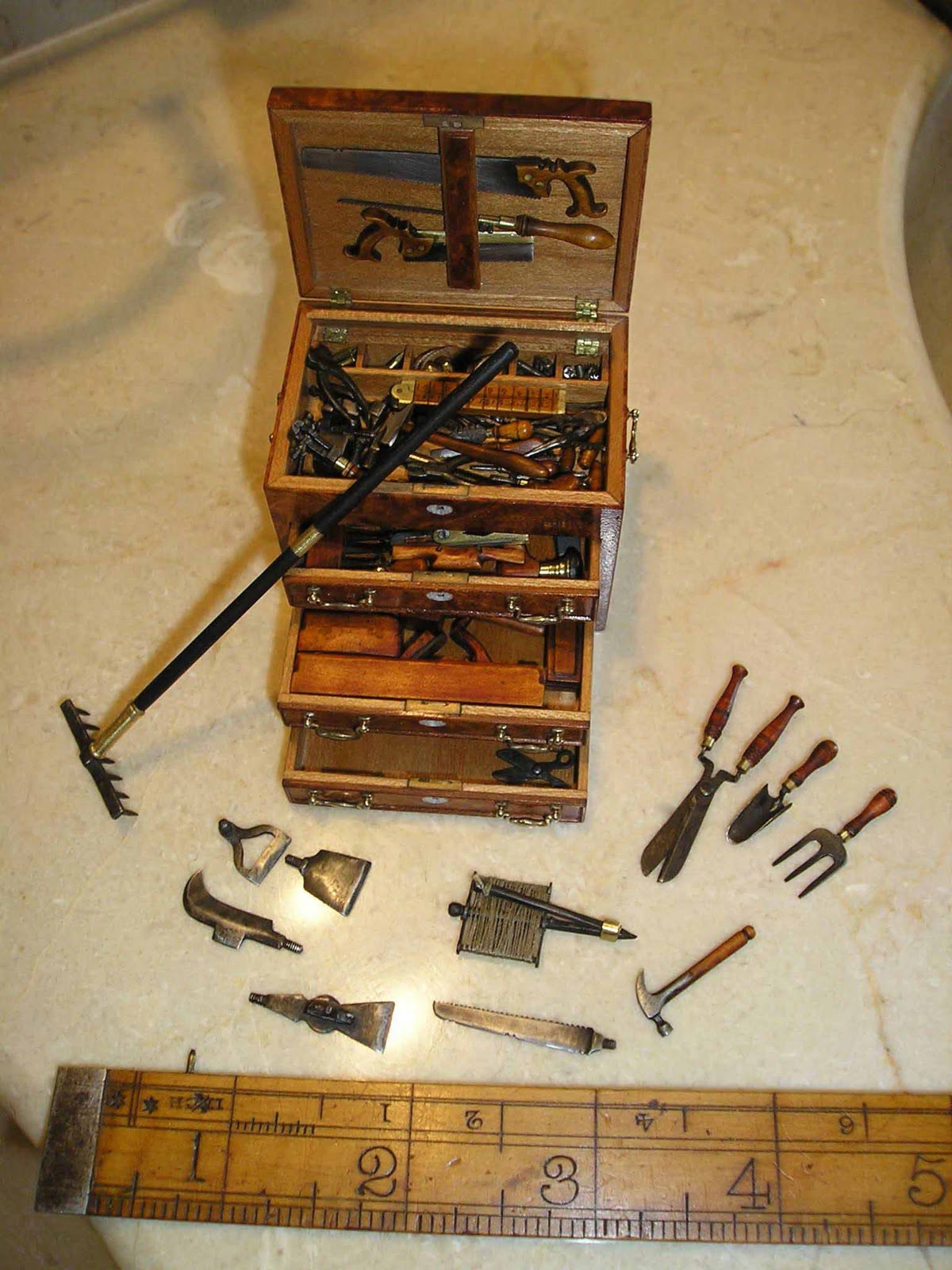
David Brookshaw's Tool Chests

Mini Tool Chest by David Brookshaw
Three years ago I wrote a blog post about a fantastic tool chest built by a Civil War vet named Henry O. Studley.  In the post, I said, "We need more nuts in this world."

Well, here's another nut.  Unlike the full-scale tools of Henry O. Studley, David Brookshaw builds miniature tools and miniature tool chests.  If I had this guy's skills, I could cram a lot more items into my truck.  (On the other hand, I'm not sure how I'd use a pipe wrench that's shorter than my pinkie finger.)

Thanks to Kari Hultman's Village Carpenter blog, which turned me onto this guy.  She has more photos of his work.

If you click on the photo, you can see more detail

Sunday, October 9, 2011

365 Jobs: Starting Out

Saturday, September 3, 1983
At Plum Court Apartments in Sunnyvale the new carpets are too high, causing doors to drag.  I'm here to trim them.  The entire unit was refurbished after an old couple moved out.

The walls are utterly bare.  The tenants have no furniture.  No chair, no table, nothing.  Two sleeping bags zipped together.  The plush carpet will be their bed.

They look like kids,
so strong and fresh.
Bright paint in the kitchen.  
Tattoos on young flesh.
The girl has one large cardboard carton; the boy, a backpack.  There's an air of hasty arrangement in their move.  Amid the high energy there's a gentleness between them, a constant checking of eyes.  Little touches.  Fingertips.  They are totally in synch.  Buoyant.  Inspiring.

Besides the box and backpack, they have a kitten which is mewing and lapping water from a bowl on the kitchen floor.  From a small radio, strange drums are blasting.

"Just married?" I ask.

"Not yet," the boy says.

The girl smiles at him, blushing.

"Oops.  Sorry," I say.

"It's cool," the girl says.

Are you pregnant?  I want to ask.

The young woman is counting their money: not enough for a pizza.  "Top Ramen," she says, and she fills a pot with water.  She glances at the boy, bites her lip, a spark in her eye.  She turns to me.  "Are you almost done?"

"I'll be out of your way in a minute," I say.

They're so in love.  So sweet.  So simple.

There's hope for us all.
.