Showing posts with label tools. Show all posts

Tuesday, April 10, 2012

George Nakashima: The Soul of a Tree


In preparing my profile of James Adams, James mentioned that he was trying to follow in the path of George Nakashima.  Naturally, I had to get my hands on a copy of Nakashima's The Soul of a Tree.  I've just read it, and it's changed my life.

What an inspiring man — both for the life he lived and the works he created.  I've written before that the Shakers were a source for my woodwork and for my method of writing.  Now I add George Nakashima as a spiritual guide, a man who once joked: "I am a Japanese Shaker."

He is best known for his tables made of large wood slabs joined by butterfly joints.  The tops are smooth while one or more edges are the natural rough edge of the tree.

I'm fascinated by his two-legged, leverage-defying conoid chairs, which must have fantastically tight joints:

As with poetry, a reviewer can best let the book speak for itself, in word and image.  Here is George Nakashima:

"Resurrection"
On resurrection: "This slab was cut from one of the great trees of England...  A deep furrow remains, giving its surface a sculptured look.  The usual market for fine timber would not find much use for such a slab, practically a reject of nature.  I have sometimes rescued these great slabs from the dump heap and sometimes, with luck, seem to give them a second chance at life as good furniture.  The natural forms with all their bumps and 'warts' survive.  To fashion such a piece of wood into fine furniture is almost an act of resurrection."

On cutting: "Usually, cutting across the crotch produces the finest figuring [on left].  This cut also provides the greatest usable width.  Cutting along the crotch [on right] results in a somewhat triangular piece of lumber with less surface area to work with.  The figuring is less intense, too.  At the point where a tree branches freely, three or more crotches may be found.  The result in the lumber can be truly extravagant figuring."

"I make any number of preliminary drawings in chalk to get a feeling for the proportion of the object we are creating.  It's easier to make a final decision where to cut if there is something to see on the board." 

"There is drama in the opening of a log — to uncover for the first time the beauty in the bole, or trunk, of a tree hidden for centuries, waiting to be given this second life."
"The key man in the process of cutting logs is the sawyer, one of the great craftsmen of our age with steady nerves and experienced judgment.  It is necessary to have an almost silent dialogue with this sawyer.  Few words are spoken, but thickness, the direction of the cut, the positioning of the log — all must be decided with precision."

On the soul of a tree: "When trees mature, it is fair and moral that they are cut for man's use, as they would soon decay and return to the earth.  Trees have a yearning to live again, perhaps to provide the beauty, strength and utility to serve man, even to become an object of great artistic worth."

 "Each flitch, each board, each plank can have only one ideal use.  The woodworker, applying a thousand skills, must find that ideal use and then shape the wood to realize its true potential."
Rough design, bookmatched walnut root
Finished bookmatched walnut root table
"The object is to make as fine a piece of furniture as is humanly possible.  The purpose is usefulness, but with a lyric quality — this is the basis of all my designs."

On hand versus power tools: "Our approach is to realize a synthesis between the hand and the machine working as a small unit."

"As much as man controls the end product, there is no disadvantage in the use of modern machinery and there is no need for embarrassment...  A power plane can do in a few minutes what might require a day or more by hand.  In a creative craft, it becomes a question of responsibility, whether it is a man or the machine that controls the work's progress."

A butterfly key of rosewood joining two pieces of walnut.

On nature: "Once I was pulling a fairly large branch and it suddenly gave way, knocking me breathless to the ground.  As it fell, two long shards of wood broke off, each fifteen to twenty inches long and as sharp as a spear.  I was wearing heavy rubber boots with leather tops.  One of the shards pierced one boot's heel, while the other slashed through it.  Lying on the ground, I waited for the pain to start, for it seemed as if I'd been crucified.  But as my senses returned, I realized the wood had gone through the boot, but not my foot: all I had were scrapes on my sole and heel.  Nature is compassionate."

Part of my feeling of kinship with the man comes from the remarkable facial resemblance between him and my own father, who was neither Japanese nor a woodcrafter.
George Nakashima
On personal history:  "Then Pearl Harbor broke, and all of us of Japanese descent were put in concentration camps.  My wife and I and our newly born daughter were sent to a camp in Idaho.  This I felt at the time was a stupid, insensitive act, one by which my country could only hurt itself.  It was a policy of unthinking racism.  Even Eskimos with only a small percentage of Japanese blood were sent to the Western desert to die."

After relocating to New Hope, Pennsylvania: "After a year of doing general farm work, it was quite clear to me that chickens and I were not compatible."
 

On building his house in New Hope:  "At no time did we have more than fifty dollars in cash, but by scrounging materials, gathering stones off the property, digging foundation by hand, and working evenings and weekends, I was able to build a rough structure by Thanksgiving. …  Our first winter in the house was bitterly cold, and the faucet froze in the kitchen."

"We built, quite literally, on the principle of laying stone upon stone.  We had considerable stone on our land, and it was simply a question of hauling it by wheelbarrow to the building site."


On architecture:  "There is a wonderful feeling to be had in erecting a stone wall.  There is a sense of order and permanence.  A good wall will last for generations and even millenia."

"The decline in quality of modern furniture is probably due in part to the use of the quick, easy and cheap dowel joint.  The decline of modern domestic architecture can be traced to the popularity of the stud wall put together with hammer and nails, a type of construction calling for no joinery at all.  By contrast, the early American house and barn with their excellent joinery still represent the best we have produced and will greatly outlast contemporary buildings."

Nakashima built several innovative structures at New Hope, blending traditional Japanese and American styles with modern materials.  This photo shows the interior of the Minguren Museum, which has a roof that is a hyperbolic parabaloid.  "The span of the room is thirty-six-by-thirty-six feet, but note that there are no trusses or beams." 
Ceiling, stairs, Minguren Museum
"The stairway is made of three-inch thick oak planks cantilevered twelve inches into a fieldstone wall."  I wonder: With one end anchored in stone and the other hanging in free air, how much do they bounce?
The reception house
On local salvage:  "I call our reception house a sanso, or 'mountain villa,' in Japanese.  I built it … entirely with materials cast off from my workshop.  Castoff though the building materials were, they were quite unique since the rich and rare woods that I normally use are not generally obtainable.  The floor, for example, is made of red birch and walnut boards with extraordinary figuring.  Most of the outside construction was done with a single dead elm.  This elm, about five feet in diameter, could not be lifted by one huge forklift, but required two.  The elm had been cut into two-and-a-half-inch-thick boards.  Once cut, there seemed to be no client demand since the wood was light in color and not unusually grained.  So, we happily used it in the reception house."

There's so much more:  Drawings by Nakashima's own hand.  Chapters about species of trees, their spiritual and practical uses.  Pages about where to cut, and why.  Architectural commentary.  Gorgeous photos of Nakashima's stunning original designs that are so lovely, you'll want to run your fingertips over the paper.  Slabs of trees that make a woodworker's heart race.  A genius of a man who enriched our lives, even if we never knew him.  


The original edition of the book is out of print (I borrowed mine from the library).  Used copies are fetching enormous prices (as are his furniture), but a new edition of the book has been released by Kodansha.  I've just bought the Kodansha version and am pleased to report that it's of excellent quality.  The man deserves no less.  


Note:  If you're interested, here's a link to the Kodansha edition at amazon.com:
The Soul of a Tree: A Master Woodworkers Reflections.

For more about George Nakashima, here are some links:

Links to some other books I've reviewed:
Religion in Wood: A book of Shaker Furniture by Edward Deming Andrews and Faith Andrews
The Mind at Work by Mark Rose

Tuesday, December 6, 2011

Flossing the Deck

Today's job is cleaning out the cracks between the boards of my deck.  Since I have about a thousand square feet of decking with a dozen giant redwood trees dropping duff all over, flossing is a big task.  For 30 years I've done it on my knees with a screwdriver or a putty knife or by running my power saw with an old blade.

This year, I googled "flossing the deck" and found this wonderful tool.  


Deckhand tool
I called up the guy who invented it, placed an order (he'll talk your ear off), and I'm pleased to report that the Deckhand tool is worth every penny of the $35 I paid for it ($25 plus shipping).  It works fast and handles well.  It saves your knees.  What used to be a multi-day job I can now do in a few hours.  Fantastic!


Flossing the deck

And hey — Santa!  If you're stumped for a holiday gift for the somebody-who-has-everything, I bet your somebody doesn't have a deck flossing tool. 

(I paid for the tool.  I get nothing for endorsing it here.)

Thursday, October 13, 2011

David Brookshaw's Tool Chests

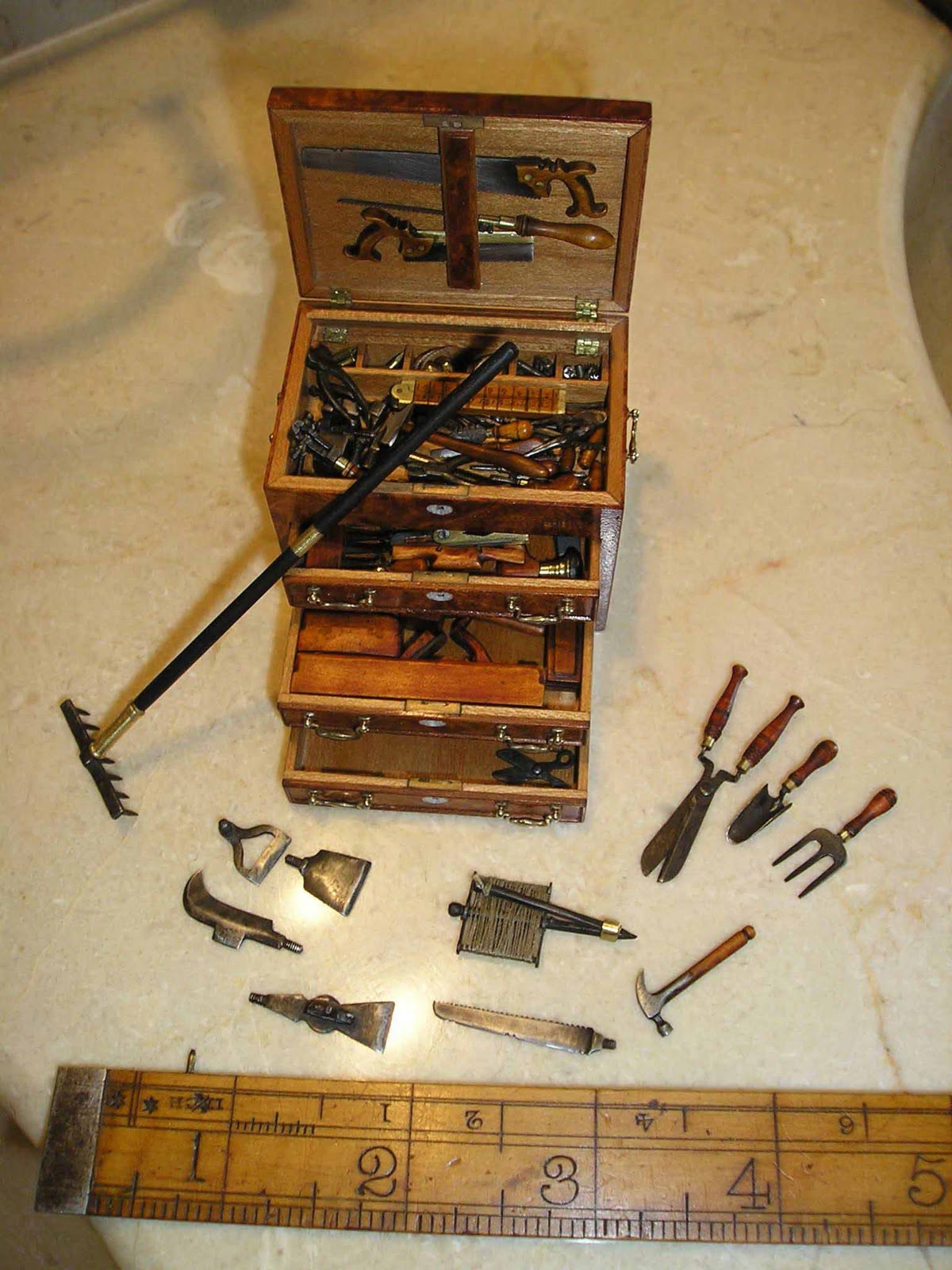
Mini Tool Chest by David Brookshaw
Three years ago I wrote a blog post about a fantastic tool chest built by a Civil War vet named Henry O. Studley.  In the post, I said, "We need more nuts in this world."

Well, here's another nut.  Unlike the full-scale tools of Henry O. Studley, David Brookshaw builds miniature tools and miniature tool chests.  If I had this guy's skills, I could cram a lot more items into my truck.  (On the other hand, I'm not sure how I'd use a pipe wrench that's shorter than my pinkie finger.)

Thanks to Kari Hultman's Village Carpenter blog, which turned me onto this guy.  She has more photos of his work.

If you click on the photo, you can see more detail

Wednesday, August 10, 2011

365 Jobs: Grandpa's Pry Bar, Grandpa's Tractor

August 10, 2011

As I picked up my grandson Raj at childcare yesterday, we passed some construction work as we were walking to the car.  We stopped to watch. 

A man in a tractor was picking up sections of a felled pine and placing the pieces of tree trunk around the edge of a parking lot as a boundary and barrier for the cars.

"It has claws!" Raj said.


Technically, it was a Gehl skid steer with a bucket loader and grapple.  An assistant on the ground with a six-foot pry bar was helping to guide the heavy sections of tree trunk onto the loader.  Once the trunk was part-way onto the bucket, the driver would lower the grapple claws, gripping the trunk and lifting.  Then he'd steer it to an edge of the parking area and set it down.

It was fun to watch if you're of the male gender and of a certain age.  Raj and I qualify on both counts, though in different age categories.  Raj is three and eleven twelfths, as he will gladly tell you.  I'm sixty-three and eleven twelfths, though I usually omit the fraction. 

Raj and I took a seat on one of the sections of pine that had already been set in place.  While we watched, the driver would give us a thumbs-up sign each time he passed.  We'd give the same sign back.

Another boy leaving childcare stopped to watch, accompanied by a cute young mother who was dressed nicely and expensively for business.  Attorney, I'd guess.  I have certain mistreated friends who would argue that the words "cute" and "attorney" cannot apply to the same person.  I'm not so extreme.

The new boy was focused on the assistant holding the pry bar.  "It's like a light saber," he said.  "I want one."

"Actually," I said, "it's solid steel and very heavy.  I know because I have one."

Surprised, his mom looked at me with amusement.  She said, "Oh, you just happen to have one lying around at your house?"

"I'm a contractor," I said.  "I have all kinds of tools."

The boy gaped at me with a new respect.  That man has his own six-foot steel bar! 

The mom regarded me differently, too.  In her world people don't have funky tools.  In my world, some people have half a dozen pry bars in various sizes.

The woman and her son stayed for five minutes, watching the skid loader, giving a thumbs up when it passed.  Then they had to go.  They had things to do.

Raj and I had nothing better to do.  And what could possibly be better than this?  In warm sun on a log, we watched.  We observed a black squirrel clutching a pine cone, confused, wondering where the tree had gone.  We touched sticky sap oozing from the rings of our log.  We kicked our bare feet through a mound of soft sawdust. 

I told Raj that next time he came to my house, I'd show him my pry bar.  I told him I really like pry bars.  Some people are strange that way.  I knew one man who treated his pry bar like a special pet. 

Raj is more likely to grow up to be an attorney than a construction worker.  I'm doing my best to keep pry bars - and the whole funky world of honest-to-God labor - part of his life.

We watched the skid loader and the man with the pry bar for the next hour and a half until they had finished the job.  We talked to them for a few minutes.  They said the tree had to be cut down because its roots were lifting the sidewalk.

"Stupid!" said Raj.

"I agree," said the man with the pry bar.

A final thumbs up, and we call it a day.  


Back at Raj's house, I've brought a pile of new books from the library.  The stars must be aligned.  Raj selects one called Grandpa's Tractor.  

In the story a boy named Timmy goes with his grandfather (named, by golly, Grandpa Joe) to an abandoned farm which has mostly been obliterated by the new houses of an expanding town.  There Timmy finds a broken down rusty tractor.  (I have to explain what rust is.)  Grandpa Joe tells Timmy about the uses of a tractor and about his life as a farmer.  Timmy declares that somebody should restore that old machine to its former glory.

We agree.
 

The book is an affirmation of our day.  As I read the story aloud, we both are spellbound.

Saturday, May 14, 2011

365 Jobs, Day 134: Boy Scout Pocketknife

Saturday, May 14, 1983

In the garage I open a drawer and am face to face with a mama rat, three babes at her teats. 

For one moment we gape.

Her instincts are faster.  She leaps to the floor
with a flop, babes clinging, dragging.  She’s gone.

In seconds I destroy her home.

Beneath the nest, soaked in life’s liquids, lies my old pocketknife, Official Boy Scout model, now rusted, stinking, filthy.  Wrecked.  


With this knife I whittled wood, punched leather, opened cans, played mumbledepeg, sliced legs off frogs.  (Sorry.)  More recently it's fallen into abuse: cutting insulation batts, trimming asphalt shingles, or just poking wood in search of termites.

My son Jesse wants it.  First grade.

I say, “It’s ruined.”

Jesse says, “I’ll fix it.”

“What will you do with it?”

“Cut things.”

He’s six.  Too young.  “You have scissors to cut.”

“I want it.”

In six years I’ve learned to recognize need.  What is it with boys and knives?  I bought this - drained my life savings - in 1955.  I wanted it.  My parents had doubts.  I needed it.  I was eight years old. 

“It’s yours, son.”

He scrubs it with steel wool and oil.

I demonstrate the whetstone, how to hold, fold.  The blade is pitted, black, but sharp.  A six-year-old with a bulging pocket, a need fulfilled, an edge that can kill.  A gift from a father … and a rat.

Saturday, February 12, 2011

365 Jobs, Day 43: Craftsman 1/4 x 8 Inch Slot-head Screwdriver, Melted

Cross-posted from my new blog, 365 Jobs:


Sunday, February 12, 1989

There's something inherently funny about screwdrivers.  As bananas are to fruit, screwdrivers are to tools.  The latent twelve-year-old in all of us wants to giggle.  Let's get over that.

Okay.  Now you can say what you will about Sears power tools (it's a whole 'nother subject), but the Craftsman people make darn good hand tools.  Like my Craftsman 1/4 x 8 inch slotted screwdriver.  Easy grip, precise head, solid construction.  It takes a while, but like a faithful friend you come to appreciate a sturdy screwdriver, especially when you're forced to grab some substitute with a point that's rounded or a grip that doesn't fit a human hand or a shaft that comes loose. 

Yesterday, I melted my trusty friend inside an accidentally energized circuit breaker panel box.

I always heard that Sears guarantees its Craftsman screwdrivers for life. 

Today out shopping with the kids, I stop at Sears in Mountain View and bring in my poor old Craftsman 1/4 x 8 inch slot-head.  It looks like I ran it through an experiment involving nuclear fission.  I expect them to laugh me out of the store.  Instead the salesman, without comment, hands me a brand new one.

It's true!  They actually guarantee for life, even if you use it like an idiot.  What suckers.

As long as we're in the store, we pick up two pairs of soccer shoes, a leotard, a yo-yo, a graphing calculator, a set of spark plugs, a floor pillow, a gas barbecue grill, and ten pounds of laundry detergent.

(Bear in mind, this happened in 1989.  I don't know if Sears still has that guarantee; but if they don't, they should.  And though slot heads are less common today, I've still got that same old driver in my toolbelt.)

Sunday, July 26, 2009

Clamps and peanut butter


Teasing, I said, "Are you sure you have enough clamps, Jim?"

James Adams replied, "A cabinet maker can never have too many clamps."

And you don't want to run out of peanut butter, either...

Thursday, July 23, 2009

A plane for curves


I just love the mechanism of this plane. Beautiful, simple, precise.

The plane belongs to my friend James Adams. He's a cabinet maker, a soccer coach, and an engaging curmudgeon residing in La Honda, California, a town where curmudgeons come home to roost - and work with wood.

Friday, May 1, 2009

The Toolbelt: Aidan Wing

Previously in this blog I've attempted to draw a portrait of a man through his tools. (See Ken Laundry.) Now it might be fun to see what one can learn from one worker's toolbelt:
His name is Aidan Wing, as you can see written on the red plastic case of Milwaukee drill bits.

First impressions: The choice of a leather toolbelt shows a preference for authentic, traditional materials even if there's a trade-off in weight or cost. The stains and dirt indicate at least a few years of hard work, but the stitching looks solid and the leather hasn't frayed or ripped. It looks comfy, broken-in but not broken-down. A relatively young belt - like the worker who wears it.

In contrast to the old-fashioned leather, the plastic case of drill bits and the purple Sharpie marker show a willingness to go modern when it's expedient. The green-handled cleanup brush in the background shows a commendable interest in tidying up, and the ear protectors show an interest in self-preservation.

As for the contents of the belt, let's spread them out:
Clearly, he's a carpenter. But also, he's an electrician. Like most electricians, he always carries a voltage tester around even when he's doing a job that is strictly carpentry (so do I). The wire cutter seems less obvious a choice, but maybe it's useful in carpentry. I usually carry my linesman's pliers in my toolbelt when doing carpentry - they just seem to come in handy sometimes for pulling a nail or bending a piece of metal. Maybe it's like that for Aidan with the wire cutters - they just seem to come in handy.

Wood handles on the hammers. Like the leather, a taste for the traditional, the time-tested, the natural. Both the framing and finish hammers show wear, whereas the cat's paw still has a pristine bar code label on its handle. Either it's new, or Aidan is so deadly accurate that he rarely needs to pull a nail. Me, I vote for new. If he were deadly accurate, why would he carry it in the toolbelt? Also, in repair work, often you're pulling other people's old nails.

The raggedy chisel blade shows a certain "oops" factor. Or maybe intentional - don't we all keep one old chisel for abusive banging and prying?

The Hyde blade is an interesting choice. From the wear marks, I'd say it's used for prying and scraping, and maybe for applying putty. Useful and light weight.

The nailsets and small hammer are for finish work, the waffle-face hammer and cat's paw and beater chisel are for banging on framing. He's not a specialist. He's been working for a while, long enough to break in a toolbelt and ding up a few tools, but not so long as to lose the blue paint on the hammer or to scuff up the square, the cat's paw, the utility knife.

He's a young man, not settled in a specialty. That's the evidence of the toolbelt.

Next post, I'll introduce him.

Thursday, March 19, 2009

Joseph Millar: Tools


Tools

I was sixty days without a drink
working the back of the Howard Street store,
cleaning the tools my boss scavenged from basements
of tradesmen's widows all over the state.

I'd sort through the wrenches, boxes and crescents
from Stanley, Craftsman, and Utica Tool,
bright sockets from Snap-On
we could charge twice as much for.
I'd polish the wrecking bars with WD-40,
the claw hammers, jack planes and pliers,
then clean up the handsaws, old Disston Brothers
and the best, London Springs,
twisting the studs from the filigreed handle
and sanding away the resinous shell,
one stroke at a time,
from the wide steel blade.

I seldom looked out through the dusty panes
at the rubble of Howard Street's
plywood-scabbed storefronts. I stayed
in the back near the cracked tubs of solvent
whose gray vapors ghosted the air
and kept my eyes lowered, watching
the grinding wheel whirr in its armature,
cutting blue rust from the chisels and knives,
washing my knuckles in sparks.

--Joseph Millar, Fortune, copyright © 2007 by Eastern Washington University Press

This poem by Joseph Millar paints a vivid picture in my mind of a man in recovery, sixty days without a drink, washing his knuckles in sparks. I knew the scruffy neighborhood of Howard Street in San Francisco, the plywood-scabbed storefronts, the winos and worse who wandered there. (The street itself is these days undergoing a form of recovery.) I can see the old tools, sense their cold metal, take pleasure in their restoration while appreciating the labor involved and the fumes from the cracked tubs of solvent. I can hear the "whirr" of the grinding wheel and feel the tingle of the sparks.

Support this craftsman. "Tools" is from the book Fortune, and you can buy it here. At $18 for the entire book, that comes to 43 cents per poem. Those are flea market prices for quality craft.

Thursday, March 5, 2009

Ken Laundry

When we leave this earth,

our spirit fills the places
we leave behind.
The spirit dwells in the small things...
and the large...

(You can click on any photo for a larger view.)

Thursday, February 26, 2009

My Top Ten (or Five, actually, or maybe Six...): Mike Rose


After posting about Jeff Taylor's book, I settled into a bath to refresh my memory of the next book I want to write about. ( I do most of my reading in the bathtub, make of it what you will.) The next book is by Mike Rose, and I see on second reading that he is a fan of Jeff Taylor, too. And just as I had lamented the lack of power tools in Jeff's book, here is what Mike Rose had to say: "Someone, following Jeff Taylor's lead, should write a subsequent book on the 'art and craft' of the power tool: an attempt to render the knack and judgment required for the router, the jointer, the band saw."

Wow. I think I'm onto a theme here. Mike Rose is almost a god. More in my next post...

My Top Ten (or Five, actually, or maybe Six...): Tools of the Trade


There are dozens of books about tools. What I love about Jeff Taylor's Tools of the Trade: The Art and Craft of Carpentry is that tools are just the starting point. Jeff is a born story-teller. The chapter on hammers, for example, isn't really about hammers. It's about, as the subtitle states, "the art and craft of carpentry." It's about his first job working for an old carpenter named Swanee. It's about Jeff's raw naivete and Swanee's years of accumulated knowledge and wisdom. It's about attitude, which is the most important tool of all.

If you've read or listened to my novel Clear Heart, you might remember Abe, the Princeton preppie, being trained by Steamboat, the big old quiet guy, with lessons about mucking in concrete and learning to "work smarter, not harder." Well, Jeff Taylor had an apprenticeship like that, working for Swanee.

From Jeff Taylor and Swanee, I learned something new about hammers, too: "Swanee showed me how he had bored out the bottom of his wooden handle almost to the head and filled it with castor oil, which bled out into the wood to make a microscopic slick on the surface; hence, fewer blisters. By capping the opening with beeswax, my mentor could dip screw threads to glide them into pilot holes."

The book imparts a lot of wisdom with self-deprecating humor. I particularly appreciate that he devotes equal attention to the tools of framing and finish carpentry as well as the workshop tools used by furniture and cabinet makers.

No power tools, though. Nobody seems to have any affection for power tools, except me. I may have to write my own book about that. In a way, Clear Heart was a start: A Duo-Fast nailgun named Debbie the Doofus was a central character, along with a Hitachi H65 forty-pound demolition hammer, several belt sanders including the legendary Porter-Cable 504, and ... Well, don't get me started. Oh, and pickup trucks, too! But, again, don't get me started...

Wednesday, February 25, 2009

My Top Ten (or Five, actually, or maybe Six...): A Splintered History of Wood

I've had this book for 6 weeks now. I'm on page 66, so I'm progressing at a rate of about 11 pages a week. Not that it's dense - far from it. It's incredibly engaging. And it's already one of my all time favorite books. At this rate, I look forward to 31 more weeks of enjoyment - and then I bet I go back to the beginning and start all over again.

The reason it's taking me so long is that everything he talks about makes me want to set the book down and tell somebody, usually my wife who isn't even interested in woodworking, about 50,000-year-old logs salvaged from New Zealand bogs. They're ancient kauri trees, and there's a photo of one slab that's 20 feet long, 5 1/2 feet wide, 4 1/2 inches thick, contains over 500 board feet of wood - and has zero knots! How can I keep reading? You just have to stop and share this with somebody. And it happens again and again, page after page.

I've just finished reading the section about blind woodworkers. Once again, I had to stop and tell my wife - and at least this time it's relevant to her work as an Occupational Therapist. She was interested in how they measure with something called a Click Ruler - a tape measure that clicks with each 1/16th of an inch that you withdraw. It sounds like something she could use in her therapy practice.

Before that, I read about a guy who chainsaws designs onto wooden pencils, and another guy who carves Ferraris out of wood, Ferraris you can drive and that also float on water. I mean, you can't just read this stuff. You have to go out and grab somebody by the collar and say, "Did you know that there's a guy in England who as a hobby has collected over 7,000 species of wood? And that's only 1/10th of the species in the world?"

The book is very reader-friendly, with easy writing and a warm personality behind the words, lots of photos. For instance, did you know that cork comes from oak trees? And have you ever wondered how cork is harvested?

Tuesday, February 24, 2009

My Top Ten (or Five, actually, or maybe Six...): Eric Sloane


I have this fantasy in which I'm a fly on the wall at a meeting between Stephen Shepherd and Eric Sloane. Together, you would have the sum of all knowledge about early American woodwork.

In A Reverence for Wood, Sloane appreciates both the practical details and the philosophy behind the design. Opening the book at random, here he is talking about doors: "In the pioneer days, doors were often symbols. Just as girls filled hope chests, young men planned doors for the houses they would someday build. A house might be built of local pine and chestnut, but the door was considered something special and the wood was often sassafras panels, apple or cherry, or even mahogany brought from the West Indies or Central America. A godly man might prefer a Christian door with stiles and rails that formed a Christian cross. A superstitious person might put a Maltese cross in the lower section and thereby make a 'witch door' to keep out the evil spirits, or frame the door with ash to make the spell more potent. (The ash tree was thought to have special magic to ward off sickness and evil spirits. No snake would cross a barrier of ash leaves.)"

Then, being a marvelous artist, he gives you this illustration:
I bought this book at a garage sale over 30 years ago, and I still learn new things when I go back to it. Let's put it this way: If Eric Sloane were alive today, we'd all be reading his blog. Imagine daily updates with this kind of detail:

My Top Ten (or Five, actually, or maybe Six...)


Kari Hultman of The Village Carpenter has posted her Top Ten woodworking books and thus moved me to consider the books that have inspired me over the years. Her bias, naturally, is for books about furniture and hand tools. One title on her list sounds like something I want to read right away - interestingly enough, it's called The Village Carpenter by Walter Rose, and I've just ordered a copy.

I think I'll tackle the books one at a time over a period of days.

Sunday, December 28, 2008

Good Night, Gorilla Glue


Ask a carpenter to repair a book, and what does he reach for? In this case, Gorilla Glue and a Pony clamp.

The book is Tails by Matthew Van Fleet. It's my grandson's book, and fortunately he has two copies, so one can be in the shop while the other is in use.

His favorite book, by the way, is Good Night, Gorilla by Peggy Rathmann. It's a wonderful story. We've read it over and over and over again, and it's still wonderful. And if it ever needs repair, I'll reach for - what else? - some Gorilla Glue.

I met Peggy at an Author's Day once when we both were visiting the same school. She's a talented and hardworking artist. Good Night, Gorilla is a marvel of color, story-telling, and psychology. The simplest books are the hardest to make - and of course, they aren't really simple at all. She's made some beauts.

Tuesday, December 23, 2008

Gloves

Because it's cold out there. Just like saw blades and screwdrivers, they're tools, and we need more than one kind. For myself, I usually wear gloves with the fingertips cut off - but then I don't live in the Adirondacks like Ken, the owner of these gloves. (Ken, by the way, just had a pacemaker installed in his chest and is feeling much better - probably out splitting firewood at this moment, at age 94).

When my fingers get cold, I lose all sensation (except constant pain). I dream of a glove that keeps fingers toasty warm, allows me to feel what I'm touching, allows a good grip on a chainsaw or a wire nut, and allows me to pick up a 6d finish nail. And while I'm dreaming, how about one that allows me to touch a live 240 volt wire - or hold a demolition hammer without sending vibrations up my arm? I keep thinking there must be a better design for gloves, and maybe there is. What do you use?

(Continuing my homage to hardware and hard work. You can click on the photo to make it larger.)