Sunday, May 15, 2011

Sue Doro: Heart, Home & Hard Hats

I previously reviewed Sue Doro's Blue Collar Goodbyes.  Checking Amazon for more titles by her, I found Heart, Home and Hard Hats along with an arrogant and mean-spirited review written by one Robert P. Beveridge of Lakewood, Ohio.  The review reveals far more about the reviewer than about the book in question.  I won't go into it except to say that the reviewer called the poems "morally and ethically ill-informed."  If this guy is so threatened by this book, I want it.

As with Blue Collar Goodbyes, the poems in Heart, Home, & Hard Hats wouldn't fare well in a university MFA seminar.  But then, Sue Doro isn't writing for a university MFA audience.  Let's stop being snotty about poetry.  Sue Doro is a factory machinist who writes with feeling about her job, her coworkers, and her family.  After reading her poems, I'd like to sit her down and buy her a beer.  Does anyone feel that way about T.S. Eliot?

Granted, if I were editing her book, I would have tossed out half the poems - like, anything with the word "womyn" in it.  The remainders would stand up nicely in a shorter, tighter edition.  


Sue opens her heart.  That's the chance a poet takes at the risk of withering scorn from the likes of Mr. Beveridge.  Morally and ethically ill-informed, indeed - for loving her husband, loving her children, for supporting her coworkers, for toiling hard at a dirty job and thinking she deserves equal pay.

Here are a couple of short ones I like:

Where's My Hammer?

number 13's still screwed up
have to whap it with a hammer
every time I want the tool bar up or down
and my arm is killing me
hammering at a funny sideways angle
all the time
told the foreman the machine was broke
he says it'll get fixed
it's on the "list"
felt like tellin' him
I got a list too…
and HE'S on it
WHERE'S MY HAMMER!?!


Paper Napkin Poem for Larry

i am writing on a paper napkin
missing you     it is after lunch
and i am waiting for a 1:30 class

i am a 37 year old school "girl"
waiting for a 1:30 afternoon
industrial math class
and missing you

for five hours this morning
i faced and turned a steel bar
to specified length
on an engine lathe
and only thought about you
in between cuts
which is right and proper
and especially safe
considering the machine parts
were spinning
at 620 revolutions per minute

so you can see
now that i'm waiting
for my 1:30 math class to start
i can spend time safely
thinking about you
loving you
and feeling good
about my life and ours
while writing
this paper napkin love poem

Heart, Home & Hard Hats was published in 1986 by Midwest Villages & Voices.  You can find it (and the vile review) here
on Amazon.

If you're interested in other tradespeople writing poetry, I've got some suggestions here.

365 Jobs, Day 135: The Old Red Raleigh

Tuesday, May 15, 1982

In cleaning out the garage one Sunday afternoon I come upon my red Raleigh bicycle, a three-speed with coaster brakes.  Now the gears are frozen, brakes locked, tires flat.  Spokes have popped.  Shoots of grass sprout from the leather seat.  When I bought that bike, Eisenhower was president. 

In my unsentimental out-with-the-crap mood, I toss the bike on top of the pile of garbage - old sinks, a warped door, shredded screens - in the back of my truck.  Which is where my son finds it. 

Jesse is all of five years old.  His eyes are wide: "What's that?"

"My old bike.  From when I was a kid.  Tomorrow it's going to the dump."

"You're throwing it away?"

"It's a wreck, Jesse."  Frame rusty, pedals stuck.  Like my body.

"Aren't you going to fix it?"

"It's too old."

"If I fix it, can I have it?"
From birth my son has grown up watching me fix things.  He simply believes I can repair anything - or at least that I'll make an attempt.  Now he wants to try. 

"Jesse, this bike would be too big for you even if you could fix it.  I got it when I was twelve years old.  It'll be seven years before you could reach the pedals."

"I'll let you use it.  Until I can."

"I think it's beyond help."

He scrapes at it with a screwdriver, bangs it with a wrench, rubs it with an oily rag.  He has no effect.  The pedals are frozen in place.  With no idea what to do, he pounds on random parts, squirts random WD-40 or sits, chin on fist, studying.

I do yard chores.  Jesse works on the bike.  For three hours.

Three hours!  This is a child in kindergarten. 

At supper it's all he can talk about.  My wife and I try to guide him down, lower his expectations.  We talk about the value of experience even when you don't succeed.  He won't listen.  My wife asks me, "Do you have to dump it tomorrow?"

"I'll leave it here."

The next day, Monday, there's little time after school.  Jesse flails at the bike.  More oil.  More banging.  I'm too busy to see exactly what he's doing.

Tuesday there's more time after school.  I go out to the driveway and help.  Or at least ease the pain of failure.  Oil has been wicking, penetrating for two days.

He's standing on a pedal with both feet, jumping up and down.

"What are you doing?"

"If I can loosen this pedal, maybe the wheels will move."

"It's not the pedal.  It's the axle bearings."

"If I could just move this pedal."  Now he bangs on it with a hammer.

I'm fond of this old machine.  From age twelve I rode it in an expanding circle over the streets of suburban Maryland to the baseball diamond, and later the movie theater, and later to the house of a girl.  Eventually I rode it on some mean streets in Philadelphia and then - strapped to the back of a Volkswagen - the Raleigh moved across a continent.  For three years I rode it to my job on the graveyard shift, a midnight ride covering ten miles.  I'd operate a computer through the night, then pedal home another ten miles at dawn.  I was riding an anachronism, a three-speed with coaster brakes in a land of ten-speeds with hand brakes.  And I had married that girl.

To Jesse I say, "You need some Liquid Wrench."

I squirt it into crannies and orifices.

Bracing my feet on the frame and my back against the garage, getting a good grip on the wheel I pull with all my might.

"Help me, Jesse."

He puts his weight into it, all forty pounds.

It moves!  Was it the wheel that groaned, or was it my spine?

More oil.  A loosening and tightening of bolts.  A flooding sensation of relief, of peace: I fix things.  We fix things, my son and I.  We'll have to buy a new front wheel.  A new tire for the rear.  Probably have to replace that old Sturmey-Archer three speed shifting lever - do they still make them?  No matter, we'll find a way.  Bless the children for their foolish hope.

"You got yourself a bike, son."

Saturday, May 14, 2011

365 Jobs, Day 134: Boy Scout Pocketknife

Saturday, May 14, 1983

In the garage I open a drawer and am face to face with a mama rat, three babes at her teats. 

For one moment we gape.

Her instincts are faster.  She leaps to the floor
with a flop, babes clinging, dragging.  She’s gone.

In seconds I destroy her home.

Beneath the nest, soaked in life’s liquids, lies my old pocketknife, Official Boy Scout model, now rusted, stinking, filthy.  Wrecked.  


With this knife I whittled wood, punched leather, opened cans, played mumbledepeg, sliced legs off frogs.  (Sorry.)  More recently it's fallen into abuse: cutting insulation batts, trimming asphalt shingles, or just poking wood in search of termites.

My son Jesse wants it.  First grade.

I say, “It’s ruined.”

Jesse says, “I’ll fix it.”

“What will you do with it?”

“Cut things.”

He’s six.  Too young.  “You have scissors to cut.”

“I want it.”

In six years I’ve learned to recognize need.  What is it with boys and knives?  I bought this - drained my life savings - in 1955.  I wanted it.  My parents had doubts.  I needed it.  I was eight years old. 

“It’s yours, son.”

He scrubs it with steel wool and oil.

I demonstrate the whetstone, how to hold, fold.  The blade is pitted, black, but sharp.  A six-year-old with a bulging pocket, a need fulfilled, an edge that can kill.  A gift from a father … and a rat.

Thursday, May 12, 2011

365 Jobs, Day 132: Old Marble Sink

May, 1981

At a garage sale in Woodside there's a lovely marble countertop with attached sink for sale.  It could have been lifted from some ancient Roman bath.  It certainly looks that old - and beaten.  The man is asking $45.  The day is late; it hasn't sold.  Rose, my wife, wants it.  So do I.

I offer $3.  The man says he could come down some, but $3 is ridiculous.

Rose asks me if the stains will come out.  Also, she asks if there's a way to smooth the rough spots on the surface.  And how do you fill those pock marks?  There's a chip on the edge.  And how can we make that crack go away?

I say I don't know; it would be a gamble to buy it but I'm willing to try.  Rose shakes her head skeptically.  

Turning to the man, who has heard every word, I ask, "Will you take four dollars?"

This is a wealthy house in a wealthy neighborhood.  They don't need the money.  The man is probably under orders to clean the crap out his garage.

We settle on $5. 

Rose and I are still constructing our new home, one room at a time, in a most unwealthy town.  While building, we are living in it - camping out, really - with two small children.  We have no money but oodles of energy.

In the library I read some books about how to restore marble.  Baking soda, then hydrogen peroxide, then bleach, with complete drying between each solution, removes the stains.  Blending white and black epoxy, I find a shade of gray that looks good for filling pock marks.  Slow, careful work.  With more work, sculpting the slow-drying epoxy, I fill the chip at the edge.

When the epoxy dries, I sand it by hand. 

The hand-sanding is tough work.  In a hardware store I find little discs you can attach to a power drill.  They work beyond my expectations.  They actually erase flaws.  

There's a hairline crack we'll just have to live with. 

If I were paid for the labor I put into this sink, it would cost a fortune.

These low-dollar, high-labor salvages make the house a somewhat odd and eclectic place.  They make it our home.  They won't appeal to the next owner, who will tear them out and eventually hold a garage sale including an old marble sink.  But that won't happen for a long time: we plan to raise children, grow old, and die here.  As of 2011 we've accomplished two thirds of that plan.

It's a common story, sweat equity.  Being children of the Sixties, homesteading had a particular appeal.  But in any era, many have done the same.

A year after finishing the sink, our new, third child takes a Roman bath:

Wednesday, May 11, 2011

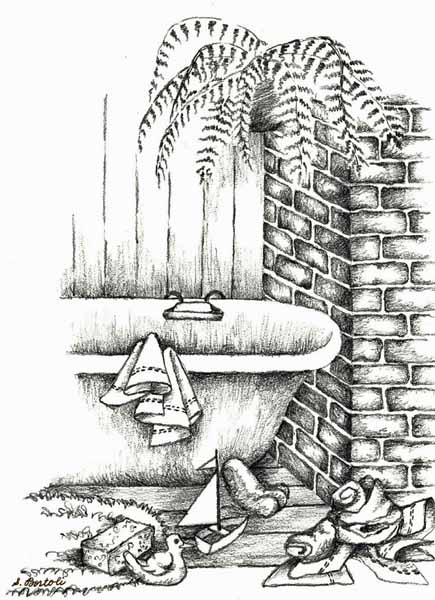
365 Jobs, Day 131: Claw-foot Bathtub

Monday, May 11, 1987
 
Drawing by Shirley Bortoli
July, 1979:
In a wrecking yard in San Jose I find treasure: a claw-foot tub almost six feet long.  Love at first sight.  From what old house did it come?  What old man soaked his weary bones here?

I'm building my new home.  I have a bad back.  I'm a bath junkie.  I listen to music, read books, even write novels while I heat my spine in warm water.  I must have that tub.

The junkyard helps load it into the back of my twuck.  At home there's nobody to help me unload, so for several days I drive around the Peninsula in a bath-twuck bringing smiles to passers-by.  If I had a little bell like the ice cream man, I could rent time-slots in my portable spa.  Eventually, a friend helps me bring it into the house.

It becomes - second to the kitchen - a focal point of home life.  There is something insanely appealing about a claw-foot tub.  This one can hold a half dozen kids.  Visiting children - and the occasional adult - often end up in the bubbles with a flotilla of toys.  My favorite is a wind-up submarine.  Also a tooting tugboat.

For six years the tub sits on the unfinished subfloor next to the old brick chimney that cuts through the bathroom.  On three sides of the tub are unadorned drywall.  It's a miracle the gypsum survives all that splashing.  We're too busy raising kids and finishing other parts of the house.

Monday, May 11, 1987:
Finally, the time comes to finish the bathroom.  We remove the old tub in order to do the work.  Once out, we see the space with fresh eyes.  Our kids are older, no longer into the group-bath scene.  A claw-foot makes for a lousy shower.  Three of the feet are broken, replaced by 4x4 blocks.  The porcelain is stained, chipped - always was, but somehow it never bothered us while the rest of the room was so rough. 

My third and youngest child is about to graduate from Nursery Blue, the same preschool my other children attended.  The staff says they'd love to have an old claw-foot on their grounds.

On May 11, 1987, once again the old tub rides in the back of my pickup (now a Ford).  At Nursery Blue twenty children climb over it for water games, sand games, puppet shows, whatever the kids can imagine.

September, 2010:
My grandson enters the warm and exciting world of Nursery Blue.  To my delight the tub is still there, now filled with dirt and planted with petunias.  I'd penciled a poem on the side.  Sometime along the years, somebody painted over what I wrote:

Grandfather Tub

I give this old claw-footed bathtub
to the citizens of Nursery Blue
and hope that someday when I
am unfashionable, rusty, chipped,
I too can be recycled
for the joy of young children.

Indeed, 24 years after the writing, I pick up my grandson from school, two days a week.  I am recycled. 

May, 2011:
The tub is gone.  Different times, different teachers, different needs.  And different health inspectors.  The county never liked the idea of a bathtub in a nursery school.

I don't know who got it.  Once again - after 32 years - the old claw-foot may be back in that junkyard down in San Jose, awaiting new children and a bath-junkie father.

Sunday, May 8, 2011

365 Jobs, Day 128: The Half-Washer Solution

Monday, May 8, 2000

It's one of those folding-down-from-the-ceiling attic ladders.  I've installed several of these over the years.  I buy the most heavy duty model I can find and yet they're always rickety - not when you install them, but as they are used over time.  This one I installed about two years ago, and already it's falling apart.  Like the house that surrounds it.

The house is much older than the ladder.  When Bill and Doris bought it, they consulted with a local contractor who advised them to blow it up with dynamite. 

They chose to keep it.  They developed a deep and abiding hatred for the San Mateo County Building Department and tried to avoid permits whenever possible.  When I came on the scene a few years later, their house became a source of steady (non-permit) work.  I had a hand in many repairs, several improvements.  We became friends, fellow poets, fellow parents - three children for each of us.  I remember encountering Doris in the grocery store when she had seven gallons of milk in her cart.  "Seven gallons for seven days," she said.  And then Bill died, much too young.

Bill was a nuclear physicist.  Like most good scientists, Bill was playful.  And like a good scientist, Bill accepted that projects don't always have the intended outcomes.  He looked for solutions that were simple, elegant, and cheap.  Usually, you can have two out of three.  Usually, elegance is the missing element.  Like the radiator hose he once used as a sink drain. 

When I originally installed the ladder, I shaved one leg slightly shorter than the other because floor and ceiling were not parallel - a normal condition in that house.  Now I see that the differing leg lengths had the unintended outcome of causing the ladder to sag to one side when someone's body weight was near the middle, at the point of maximum stress.

The ladder needs an adjustment because one of the metal joints has bent from the strain.  There's a gap between wood and metal.  The solution is to add a metal washer to a quarter-inch bolt - no, wait, the wood is twisted…  Okay, the solution - after some work with a hack saw - is to add one half of an extra-wide metal washer, like half a flattened donut, held in place with epoxy.  The donut-washer will act as a shim. 

Next problem: a C clamp squeezes the half-washer out.  Next adjustment: I wrap the assembly in blue painter's tape to hold the washer in place until the epoxy is hard.

Removing the tape, the half-washer and epoxy don't even show.  The ladder feels solid again.

You won't find this solution in any repair manual.  Simple, elegant, cheap.  With bonus points for being creative.

We all do it: cope, patch, invent.  Sometimes this work feels like play.

Somewhere in heaven, I imagine Bill is watching, approving, smiling down at me.

(There's more about Bill Ash here and here.)

Saturday, May 7, 2011

Sue Doro: Blue Collar Goodbyes

Sue Doro was a machinist for the Milwaukee Road Railway and, before that, for Allis Chalmers Tractor in Milwaukee.  

Her book Blue Collar Goodbyes is a collection of poetry drawn from her experience working lathes and big machines in the Rust Belt.

These are blue collar poems by a blue collar writer.  No academic finery here.  No arch irony.  She has something to say and she says it.  


I like that.

I especially like this one:

Red Dust

Davey was a clerk at the railroad
sixteen years union seniority gaining him
a seat outside the bathroom
in the foreman's office
behind a desk smokestacked high with papers

Only Native American in the wheel shop
he tried to bury his identity
for survival in white territory

Became more christian than the christians
to ward off totem pole humor

Carried his bible around for protection
when stepping out into the shop

Just in case he was confronted
with the booming noise of brass hammers
drumming a dubious "tom-tom" beat
on the sides of steel barrels

At least they wouldn't dare a racist joke to his face
when confronted with a sign of the crucifix and
"aw, it's somethin' to do" the guys would say
when I'd ask about intent

Then one afternoon alone together in the office
Davey confided with a conspiratory wink
that he continued to honor his mother's religion
of wind rain and sun in the event
the white man's god fell through

Recounted tales of his childhood on the reservation
his real name Red Dust
his land in northern Wisconsin
settling over graves of friends and relatives
where he returns to hunt with his sons
each Thanksgiving weekend

And the last days before the railroad shut down
saw his bible lying on the desk
gathering dust
closed over a blood-red beaded bookmark
Blue Collar Goodbyes was published in 1992 by Papier-Mache Press.  It seemed to be out of print, so I bought a used copy from amazon.  Later I found this link, which might still work if you want a brand new copy.

If you're interested in other tradespeople writing poetry, I've got some suggestions in this post called Poets Pounding Nails.