


The podiobooks.com web site is down until Friday. Apparently, too many of you folks have been downloading my (and other's) free podcasts. They're upgrading the server right now.
If you're having trouble getting your next episode of Clear Heart or Babcock or any other podcast, I'm sorry. Please hang on.
The upgrade is expensive. Podiobooks is a labor of love (in the extreme of unprofit) and depends on donations. When they're back on the air, please think about a donation.
Tuesday, January 18, 2011


365 Jobs, Day 18 -- Frida Kahlo on Drugs
Cross-posted from my new blog, 365 Jobs:
Wednesday, January 18, 1995
Justine is an artist with big dangling earrings and a gypsy rag around her hair. An attractive woman, thirtyish, with a dimpled smile, she bought a wreck of an old house in La Honda and simply maintains it - that is, she hires me to maintain it, calling me frequently to replace a faucet washer or clean a gutter.
We joke a lot. I tell her that her paintings look like what would happen if Frida Kahlo dropped acid. She laughs. "That'll be my epitaph: Frida Kahlo on drugs."
As I work today, she's painting what appears to be a naked woman with a red body undergoing an abortion performed by lizards.
I'm a licensed General Contractor, insured and bonded, charging my full professional rate. My job today is to hang a curtain rod, mend a door latch, replace a light bulb. I tell her, "You should get a husband or at least a boyfriend, Justine. This is honey-do stuff. Think of all the money you'd save."
"You're expensive." She stabs black paint at her canvas. "But you're cheaper than keeping a man around the house. And you're a lot less trouble."
Sunday, January 16, 2011
365 Jobs, Day 16 -- Cracking Glass
Cross-posted from my new blog, 365 Jobs:
Friday, January 16, 1987
I'm supposed to remove four fixed-pane windows, replace the wood that's framing them, then re-install the window glass. The problem: they used a permanent adhesive. The glass is bonded to the wood. Carefully I work a knife around the edge, then a chisel, but the glue is solid. I pry.
The first pane cracks. They used regular glass. These days, you have to use tempered. It will cost $115 for one sheet. And then there's unexpected rot inside the wall. And then two more panes crack.
I woefully underestimated this job. I quoted $350 and it's going to cost $1600.
Fortunately, it's a house in Atherton where money pours like wine. Arlene understands.
"Since you have to replace the panes anyway, would you like insulated glass? There's a lot of heat loss here."
"Yes. Excellent."
"It will double the cost."
"Okay."
She's older than me, bespectacled, wrinkly, grandmotherly while wearing a cable knit sweater, blue jeans, and jogging shoes. She sits in an easy chair reading a book, occasionally glancing up to watch me work.
I cover the openings. The room becomes dark. From the plywood comes the smell of urea formaldehyde glue. Arlene takes her book to another room.
At noon she goes out to Arby's, returns with an extra turkey sandwich. "Take a break," she says. "Join me."
In the dining room surrounded by photos of children, grandchildren, weddings and birthdays, we sit in plush black chairs on opposite sides of the table.
"What are you reading?" I ask.
With an embarrassed little giggle, she shows me a book called The Male Member. "It's about penises," she says. "Or is it peni?" She smiles. "It's mostly crap. Did you know the Russians claim that Hitler had only one testicle?"
"Uh, no. I didn't know that."
"The author's an artist. I'm a scientist." Arelene shrugs. "According to the author, Rasputin had a thirteen incher. Now it's in an ornate wooden box on top of a dresser in Paris. Supposedly it looks like an overripe banana." She laughs. She's animated. "Napoleon's shrank to one inch as he was dying of arsenic. Havelock Ellis - you know who he is?"
"Uh, no."
"He invented narcissism. That is, he named it. But also he wrote and researched about sex simply to learn what it was like. He was impotent. At age sixty he cured his impotence and promptly stopped writing about sex. Freud was impotent also, from cocaine." She pauses, thinking. "Now that I believe."
In repair work, I enter people's houses. It's always slightly, awkwardly intimate. But there are certain invisible shields you try to maintain between employer and employed, between man and woman, between aged and young. Arlene is shattering all of them.
What next? Is she going to ask about my, uh, member? I could tell her I'm less than Rasputin but more than Napoleon.
In the spirit of the conversation I have one diverting fact at my disposal, something I've recently learned in a random discussion about body sugar, so I ask, "Does that book talk about semen?"
"I don't know," she says. "I've been skipping around."
"Did you know that semen contains fructose? It causes the sperm to take off like a shot."
"Where'd you learn that?"
"From my doctor."
Arlene frowns. "Oh, I'm so sorry."
"No no, I'm fine," I say.
From then on, she seems to treat me with pity. Which is a relief, actually. The shields seem to be back in place.
When I return a few days later to install the new panes, on her coffee table is a different book: You're Only Old Once. It's by Dr. Seuss.
Saturday, January 15, 2011
365 Jobs, Day 15 -- Dimmer Switch
Cross-posted from my new blog, 365 Jobs:
Tuesday, January 15, 1991
Bertha on the telephone gets my total attention with her first words: "You remember that dimmer switch you installed? It caught on fire."
Before I can go to Bertha's house, I drop the kids at school. On the play field there is a Peace Circle - parents, teachers, kids all standing in a circle, heads bowed, holding hands. The deadline for Iraq - the line in the sand for Saddam Hussein to begin withdrawing from Kuwait - is tonight. I've been maintaining that there will be no war - that Saddam will withdraw, that he isn't stupid. The sight of the Peace Circle moves me to tears - it seems so touching, so naive, so earnest - but I don't join them. I have the damage of a fire to put out. My client is upset; I'm upset. Looking back, though, I wish I'd lingered a few moments instead of rushing off. I wish I'd held hands with my kids and their teachers in a silent circle of peace.
Two years ago when I installed Bertha's dimmer switch, I knew the risk. The rating was for 1000 watts, and the lights added up to 975 watts. A higher-rated switch would have ugly cooling fins exposed outside the wall, looking like heavy industrial equipment in Bertha's nice kitchen. At the time of installation I told Bertha that if the switch failed, I'd replace it with a higher-rated one and only charge her for the cost of the switch, not for labor. In retrospect it was a well-meant but stupid decision. I didn't realize that failure could mean catching on fire. Fortunately I'd used a steel box and sealed it correctly, so the damage was limited to inside the electric box.
Bertha doesn't even blame me. In her mind, it was simply a defective switch. She just wants her lights to work. She has no memory of my warning that the switch might fail or of my promise, should it fail, to bill only for the switch, not for labor.
I could charge her for the labor. But I don't.
At my next job, same day, Red is a psychiatrist and a heck of a nice guy. I've worked at his house several times. Today for the first time Red wants me to work at his clinic, which he shares with four other headshrinkers. They want sound-deadening flaps installed at the bottoms of each of their fancy office doors. Apparently, patients are uneasy revealing their darkest secrets when they can be overheard in the waiting room. People are funny that way.
"Your charges are always fair," Red tells me, "but this time you're charging the whole group, not just me. These guys…" He shakes his head. "You could pad the bill."
I like Red. He comes from humble origins. He thinks his colleagues are a bunch of rich jerks.
So do I pad the bill? Well, not really. But I do round a couple numbers to the upside.
After school I take my son to buy a new pair of shoes at a crappy discount store. We purchase a pair of hightops for him and a pair of jogging shoes for me. At the checkout I get confused - as does the cashier - and later reviewing the receipt I figure out that I paid 28 cents for some $21 shoes. Basically, the cashier shortchanged himself and I was pleased that the total was less than I expected. The cashier may have to pay for his mistake. He’s just a kid. I feel bad about it. I was mad at the store because the service had been so lousy - it was overcrowded, swamped - and I was confused at the register, but still, the bottom line is, I think I cheated the kid by not questioning the transaction at the time.
So I have a day of moral choices. Some I handle better than others. If only I'd joined that Peace Circle, just for a few moments… The total of all the little choices we make, multiplied by billions of people, becomes the world we live in.
The next day, when I turn on the news, bombs are falling in Baghdad.
Friday, January 14, 2011
365 Jobs, Day 14 -- Butcher Block
Cross-posted from my new blog, 365 Jobs:
Saturday, January 14, 1978
Paul is a young mobile communications salesman (this is 1978, so it's cb radio) who just bought his first house, a classic Eichler in South Palo Alto. He's a year out of San Jose State, former president of his fraternity, good-looking with slick black hair and aviator glasses, neatly dressed, natural manners. He's got a Corvette and a winning smile. On the mantle is a wedding photo: Paul with a pretty woman. She's thin, radiant.
He watches me replace a section of Formica counter with butcher block - very trendy - while fielding phone calls inviting him to a wine-tasting in Napa, a gallery opening in San Francisco, a party in Marin. He's the Palo Alto dream: young, successful, blessed. In his presence I'm the schlub: older, less successful, eight years out of college and working as a carpenter. By choice, mind you. But still…
Between phone calls, Paul lends me a hand lifting the countertop, holding brackets in place while I screw them in. The countertop needs a bit of cutting and sanding, as nothing in the existing kitchen is perfectly square. I take it slowly, do it right.
At the end of the job as he's writing the check, Paul says, "Hey, if you need any help on a weekend job, give me a call, okay? All it takes is a hammer and a screwdriver, right? And anybody could use a few extra bucks, right?" He smiles that almost-winning grin. It occurs to me that there's not a trace of a woman's presence in the house.
It's a facade. He's going down.
"I'll call you when something comes up," I say.
I never call.
Wednesday, January 12, 2011
365 Jobs, Day 12 -- Scooter Board Ramp
Tuesday, January 12, 1982
 It's called a scooter board ramp. I built my first one on this day, 29 years ago. I've had to repair it a few times as kids have pounded it over the years.
Pediatric occupational therapists use scooter boards in treating kids who have various motion or balance issues. Here's a picture of a commercial model in use:

The kids don't think of it as therapy; they're just having a blast. OT's are tricky that way.
The plywood base of the commercial model is sturdier than the 1x3 legs I used. I had wanted to use plywood, too, but weight was an issue, and I was building a customized model to the exacting needs of one particular OT: my wife. So I chose the less sturdy design, knowing I'd be on call to make occasional repairs.
My version uses a 1" dowel as a hinge, allowing the ramp to be folded back over the platform when not in use. Or the ramp can simply be lifted and stored elsewhere. Here are some close-ups of the hinge detail:


The platform is 12" above the floor. Its dimensions are 22" by 34". The ramp is 24 1/2" wide (to fit outside the platform at the hinge) by 41" long.
Here's how it looks, folded:
 and open:
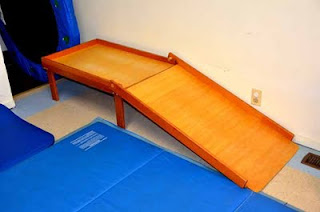
It's a pleasure to build something that gives joy on a daily basis while helping kids in therapy.

Pediatric occupational therapists use scooter boards in treating kids who have various motion or balance issues. Here's a picture of a commercial model in use:

The kids don't think of it as therapy; they're just having a blast. OT's are tricky that way.
The plywood base of the commercial model is sturdier than the 1x3 legs I used. I had wanted to use plywood, too, but weight was an issue, and I was building a customized model to the exacting needs of one particular OT: my wife. So I chose the less sturdy design, knowing I'd be on call to make occasional repairs.
My version uses a 1" dowel as a hinge, allowing the ramp to be folded back over the platform when not in use. Or the ramp can simply be lifted and stored elsewhere. Here are some close-ups of the hinge detail:


The platform is 12" above the floor. Its dimensions are 22" by 34". The ramp is 24 1/2" wide (to fit outside the platform at the hinge) by 41" long.
Here's how it looks, folded:


It's a pleasure to build something that gives joy on a daily basis while helping kids in therapy.
Tuesday, January 11, 2011
365 Jobs, Day 11 -- The Professor's Wife
Cross-posted from my new blog, 365 Jobs:
Wednesday, January 11, 1984
Betsy, who usually takes a while to get to the point, is telling me about her sister, Shelly: "Shelly got married in college. Her husband was a graduate student. He became a professor. They lived in Nebraska. After fifteen years he came home one day and said, 'I don't love you. I never loved you.' She came to California and now she's making minimum wage at Walgreen's. She's taking classes in accounting. You need to help her."
"Help her how?"
"Her bathtub."
It's a tiny cottage in Los Altos. Shelly has a pretty face that would delight a cubist painter: chiseled, not curved. Her voice is gentle; her smile, wide.
I tell her the ultimate solution is to tear out the wall, rebuild and retile. She can't afford it. The landlord should pay but she doesn't want to "bother" him. We come up with a less elegant repair: a gooey fiberglass mixture that I will apply by hand. When dry, it will seal out the water and buy a few years before the whole wall collapses.
I've never applied fiberglass before. It takes more hours and more materials than I expected. The fumes space me out. It doesn't tool well and I can't get it smooth. At one point while I'm working Shelly stands in the doorway, watching, and after some small talk she finally asks, "Do you have children? Just wondering. I saw the little bear on the dashboard of your truck."
"Three kids," I say.
Somehow, that was the wrong answer. Her face clouds over. She walks away.
I pile some debris, grout and broken tile, on the bathroom floor. Shelly returns to the doorway. "Did you always want children?"
"No," I say cautiously.
"What changed your mind?"
"It wasn't like I didn't want children ever. It was more like I wasn't ready. And then one day, I realized I was ready."
"How long did that take?"
"We'd been married, um, six years. It was our anniversary, actually, when I told her."
"And your wife - was she ready?"
"She had to think about it."
"How long?"
"About thirty seconds."
"You're blushing!"
So I am. Meanwhile, a cat has pawed a little hole in my pile of debris and is squatting over it. "I'm so sorry," Shelly says. She sweeps up the pile and then sprays the floor with Lysol. As she scrubs, she asks, "What made you ready?"
"I don't know. I just was."
The floor is clean now, but she continues scrubbing, not meeting my eye. "You see, I met this young man. I mean, young. For some reason he likes me. So I was just wondering."
I don't know what makes me say it, maybe a protective instinct, but I ask, "Is he nice?"
There's an intake of breath, a hesitation. Then she says, "He's lovely."
I don't finish until 8 pm. It looks slapdash and may not even hold. I hate doing this kind of repair, so temporary, so ugly, and not inexpensive.
I clean up. Shelly inspects the work.
"Sorry," I say. "Maybe I could come back tomorrow and do something better."
"No, it's lovely," she says, and she writes me a check.
Subscribe to:
Posts (Atom)