Showing posts with label Sullivan's. Show all posts

Monday, April 25, 2011

Lit Night in La Honda

My Google statistics show that this blog has a few readers in Brazil, Australia, China, Russia, Iran, Germany, Pacific Islands...

I want all of you to know you're invited to the next La Honda Lit Night - or any La Honda Lit Night.

They take place the last Wednesday of every month at Sullivan's Pub starting at 7 pm.  You can come early for dinner. 

Have a beer, a glass of wine, and listen to some audience-friendly poems and stories - or read your own.

Next Lit Night is Wednesday, April 27.

Here we are as discussed in the New Yorker magazine.

Here is our weapons policy.

I'll be there.  Hope to see ya!

Wednesday, March 23, 2011

Lit Night in La Honda

Wednesday, March 30, just as we do every last Wednesday of every month, the writers and readers of La Honda will emerge from beneath the mushrooms and converge at Sullivan's Pub for an open mic reading.  We call it Lit Night.  I'll be hosting along with Terry Adams, plumber and poet laureate of La Honda.  Have a beer or a glass of wine, buy a salad, give a listen or read your own masterwork.  Ages 10 to 100 are welcome.  Food and drink start at 5.  Reading starts at 7.

Wednesday, February 23, 2011

Lit Night in La Honda

Tonight, 7 pm, at Sullivan's.  Join us: eat, drink, and be literary...

Thursday, February 3, 2011

Lit Night in La Honda

We're still doing Lit Night, last Wednesday of every month, at Sullivan's Pub in busy downtown La Honda.


Our January event was the best yet.

It's lovely to watch how our home-grown writers and readers are developing.

They are getting more comfortable in the limelight (a very mellow limelight).


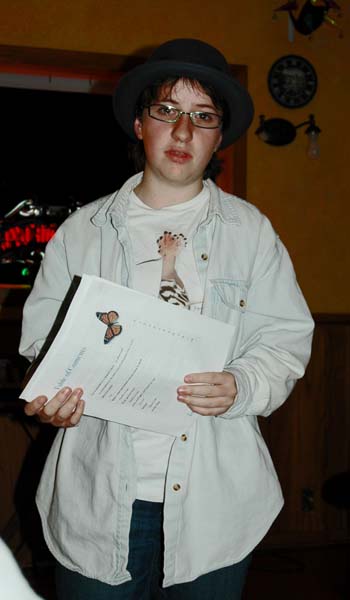
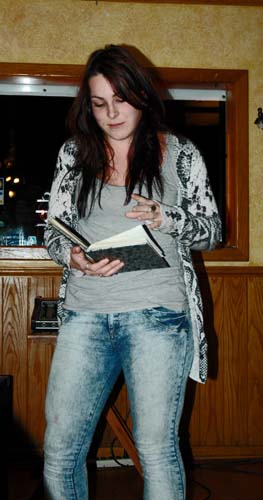
Here are some of them.

Thursday, September 2, 2010

Meet Ann Emerson

(I wrote this article for the La Honda Voice newspaper.  Oddly, some people on this planet don't subscribe to the Voice, so I thought I'd repost an expanded version here with some additional comments.)

Not the Last
by Ann Emerson
-- with gratitude to Jane Hirshfield

In this story I am an old animal
and not sad in the way people think

about horses vanishing in the West.
Stanford Cancer Center.  The hills behind the

research lab are stitched tight with barbed wire.
Things now are just as they said it would be:

steel devices and PKC412.
End-stage: I am a feral horse untouched

by human hands, lithe as grasses on
high plains.  Pink gasps of lungs for air.

This isn’t the last poem I will write about
orchids on the desks of doctors from grateful

families of the dead.  Here, in this closed
room, I grow restless pricked with silver

hooks and tools.  I am not sad no one
has figured me out and I do not wonder why things

turn out as they do: my sky pouring gold through
the window, the crack of wind setting me free.

Meet Ann Emerson
by Joe Cottonwood

Ann Emerson self-portrait
You may not have met Ann Emerson, though she's been living in La Honda for a couple of years.  "I'm kind of a hermit," she says. 

Four and a half years ago, Ann learned that she has a rare form of cancer called malignant mastocytosis.  She was given 3 to 5 years to live.  "This prognosis was very good," she says, "because now I know there's an end in sight.  I'm at heart very lazy.  I need to evolve.  Now there's a compression of time, an intensity.  I'm more selective about who I spend my time with." 

Mostly, she spends her time with two old cats at her little cabin in the redwoods in a chair overlooking San Gregorio Creek, where she writes poetry.  She calls her home Lazy Eye Ranch in honor of a lazy-eyed cat.

Besides writing poetry, Ann runs something of a hospice for old cats, usually blind ones.  "I've always worked with dying animals," she says.  Currently she cares for two of them, Blinky (one-eyed) and Babar.  In boxes by the window are the ashes of 3 cats who have passed on: Wabisabi, Flossy, and Piccola.  "When I die," Ann says, "I want my ashes mixed with theirs."
Ashes

Morbid?  Depressing?  Not at all.  Spending time with Ann is to be embraced by the clarity of her life, her spirit, all of which shines through her poems.

Born in Oakland in 1954, Ann grew up in a not-so-good neighborhood in Richmond until 1968 when it was destroyed in the rioting after the assassination of Martin Luther King.  Her father was a professor of medieval musicology; her mother was a child prodigy concert pianist who at age 8 appeared in Steinway ads, but who gave it all up, as was expected in the 1950's, to raise Ann.  Her mother became a reference librarian in the Richmond Library, where Ann would hang out and read everything, first children's books and then moving to the adult section.

Ann in 1976
Ann majored in Physiology at U.C. Berkeley and wanted to be a veterinarian, but the Dean of the Vet School at U.C. Davis "chewed me out, called me a hippie (I had hair down to my butt) and told me he wouldn't admit me because I was only going to drop out and have babies."  This was 1975.

So instead of veterinary science, Ann studied literature in graduate school but only as an academic pursuit, never as a creative writer.  In those days (and perhaps still) there was a strict boundary: You were either academic or creative, never combined.

At age 27 Ann worked with Mother Teresa in Calcutta.  "She was a pistol," Ann says.  "A tough cookie.  A down to earth, gritty woman.  She took no personal interest.  To her, all that matters is your service to others."   On a wall of Ann’s cabin hang the words:
Three things in human life
are important;
The first is to be kind.
The second is to be kind.
The third is to be kind.
  --Mother Teresa

Ann worked for 20 years in the California Employment Training Panel, an agency started by Governor Jerry Brown to retrain workers.  For 15 of those years Ann visited employers, meeting CEO's, helping workers from the cubicles of Silicon Valley to the hot fields of broccoli farmers.  What she learned, she says, is that "American workers work really hard."
Blinky
Finally, with her illness, Ann had to quit.  She can't go more than a few hours without sleep.  With the clarity coming of a life-threatening illness (Ann, in her Buddhist group, doesn't use the word "terminal"), Ann came to see many of her acquaintances as shallow, concerned with shopping and shoes.  She gave up her life in San Carlos and moved to a little cabin in the redwoods.  Meanwhile, she joined an experimental writing class offered to cancer patients at Stanford.  Under teacher Sharon Bray, she discovered she had a calling as a poet.  At last she is a creator, not an academic.  And she is blossoming.  Now she meets with Ellen Bass, a Santa Cruz poet, and had an inspiring encounter with the poet Jane Hirshfield.

Ann has turned to poetry with a passion.  "You go for broke," she says.  Her lessons from Mother Teresa ("All that matters is your service to others"), from broccoli farmers ("American workers work really hard"), and from her own trials with chemo and blood transfusions and all the medical technology that Stanford can bring to bear, have taught her this: "It's not what you do but how you do it.  You do it with all your heart and all your passion."

And this: "Getting cancer was the best thing that ever happened to me."
 After posting this article, Jane Hirshfield commented:
The finished poem is perfect, more than perfect--it is devastating and gorgeous and true.
Thank you for this story--and Ann, thank you, for your presence, your words, and your teaching--
Ann keeps a journal at the wonderful website CaringBridge.

There's more about Ann Emerson here:
Ann Emerson, continued...
  

Wednesday, July 14, 2010

Lit Night at Sullivan's Pub

Caroline Graham, one of La Honda's talented teens, joined with me at the most recent Lit Nite to read a few passages from a novel of mine, a work-in-progress that might have the title Jesus at the Mall or perhaps Wormheads.  We'll record it as a podcast later this year.  (Copyright © 2010 by Joe Cottonwood.)
     Jaz Lee hung up the phone and saw that her mother was staring.     “Who was that?” Linda Lee asked.
     “Hoot.”
     “Hoot?  He’s a bird?”
     “No.  He’s a kid.”
     "Does he go to your school?”
     “Yes.”  For some reason, Jaz felt herself blushing.
     “Is he a nice boy?”
     “He collects waterfalls.”
     Jaz knew she was turning bright red.  Trying to avoid her mother’s probing gaze, Jaz swept her eyes around the kitchen — and noticed a shiny white toaster.
     “What’s that?”
     “Oh.  I got a new toaster.”
     “You what?”
     “It was broken, Jasmine.  So I got a new one.”
     “Couldn’t we fix it?”
     “Jasmine, you don’t repair toasters.  You replace them.”
     “But we had that toaster all my life.”
     “You want it, Jasmine?  It’s in the garbage.  You can keep it in your room if it’ll make you happy.”
     “Mo-ther.  That isn’t the point.”
     “What is the point?”
     “The point is you got a new toaster.  And it’s white.  Toasters are chrome.  We’ve always had a chrome toaster.  All my entire life.  How could you?”
     Linda Lee sighed.  She folded her arms.
     Jaz recognized the expression on her mother’s face, the grim forbearance.  She’d known that look all her life.  It was reassuring, somehow.  Cozy and constant.  Like an old Christmas carol.  And Jaz was being unreasonable; she knew the toaster wasn’t the issue — and so did her mother who was asking, "What are we talking about, Jaz?  I mean, really."
     "Nothing."
     "Did somebody die?  Is it about death?"
     "Nobody died, Mom."
     "Then what are we—"
     The phone rang.
     Jaz answered.  “Hello?”
     “It’s me.  Hoot.”
     “What do you want?”  It sounded a little harsher than she intended.  But she didn’t know how to take it back.
     “Is there a Hair Nebula?”
     “God, Hoot.  I have no idea.”
     “Well, I just painted one.”
     “What are you talking about?”
     “I thought you knew about nebulae.”
     “Well I don’t know all their names.”
     “Oh.  Okay.”
     He hung up.
     Jaz stared at the phone in her hand.
     Her mother was watching.  “Who was that?”
     “Hoot.”
     Linda Lee was shaking her head, smiling.  “So now boys are calling my darling daughter.”
     “No they’re not.”
     “Oh.  Excuse me.”
     “We were just talking.”
     “Right.  Absolutely.”
     Jaz watched as her mother went to the refrigerator and took out a gallon jar of pickles.  Removing the lid, she started fishing with a pair of tongs for the last kosher dill.
     “MOTHER STOP!”
     Linda Lee looked up.  “What?”
     “Don’t take that pickle.”
     “Why not?”
     “It’s the last one.”
     “You want it?”
     “No!”
     “Then what—?”
     “If you take it, they’ll be gone.”
     “We can buy another jar.”
     “That isn’t the point.”
     “What is the point?”
     “The point is that’s the last pickle.  And if you take it, they’ll all be gone.  Forever.”
     "Okay, now I get it."  Her mother put the pickle jar back in the refrigerator.  "I understand."
     "You do?"
     “You’ve got a birthday coming up.  Fourteen."
     "So?"
     "You're ambivalent."
     "Ambivalent?  I don't have a choice."
     "Precisely.  Even the late bloomer has to bloom.  But I can offer one choice.  Of course I like to surprise you but I’m just wondering:  You want anything in particular?”
     “Yes.  A … ring.”
     “Any old ring?”
     “A navel ring.”
     “From the navy?”
     “Na-vel.  With an e.”
     “Jasmine?  Is a navel ring what I think it is?  Is it something you put around your belly button?”
     “Actually, I think it goes through the little fold of skin just above.”
     “Through?”
     “Like, pierced.  You know.”
     “I’ll have to talk this one over with your father.”
     “That means no, doesn’t it?”
     “Why do you want a navel ring?”
     “Because … Mimi Bucher doesn’t have one.  She wouldn’t have one.  She’s too cute.  She’s bought.”
     “She bought what?  Who’s Mimi Bucher?”
     “She’s somebody who would never have a navel ring.  Now do you understand?”
     “I’m not sure I like this idea, Jasmine.”
     “There’s a shop that’ll pierce it but I have to get parental consent.  You sign it.  A form.”
     “I don’t know, Jasmine.  I don’t know how sanitary this is.  And more than that, I don’t know about the idea of putting rings in a place like that.  I’m not sure you understand how it might seem.  How it might look.  To boys, I mean.  You never let me talk about this, but you’re becoming a young woman.  Boys are starting to notice and we need to talk about—”
     “No no no no no no no no no no no no no no no no no no no no no no no no no!”
     Jaz opened her eyes, unplugged her ears, and saw that her mother was standing with arms folded, fuming.  “I understand ignorance, but I cannot tolerate willful ignorance.  Read the book.  That book.  WILL YOU PLEASE READ THE BOOK I GAVE YOU?”
     “Will you ask Dad?  About the ring?”
     “Yes.  We will definitely talk.”
     “Thanks, Mom.”
     Jaz danced a little jig step that took her right out of the kitchen and up to her room and her cat and her stuffed animals on a shelf all in a row.
     Jaz sat on the bed.  Her eyes caught sight of the book her mother had given her — Our Bodies, Ourselves — which she’d never read, which she didn’t need.  She’d learned all that stuff back in third grade, and she wouldn’t get pregnant.  Not the first time.  You can’t get pregnant the first time.  That's what she learned in third grade, and the facts don't change.  And after that first time, if you don’t want to get pregnant, all you have to do is hold your breath while you do it.  Nobody ever gets pregnant if you hold your breath.  Facts don't change.   They just don't.
     Jaz opened the Oxford Book of Christmas Carols, then set it on her chest as she lay back.  She hummed The First Noel.  She made up better words.  Softly she shared the carol with the stuffed animals she had played with, the cat she had loved, the room where she had lived all her whole entire life.
     *****
   

     *****

    Jaz peered in the eyepiece and adjusted the focus knob.
    “Here, Hoot, take a look.”
     They were in Jaz’s back yard.  Light streamed from windows.
     Hoot bent to the telescope.
     “See ’em?”  Jaz asked.
     “I see a bunch of stars.”
     “Those are the Pleiades.  The Seven Sisters.  Except with magnification you can see more than seven.  Can you see haloes?”
     “You mean they’re angels?”
     “The stars.  Each Pleiad.  They have haloes.  Sort of bluish white.  Can you see?”
     “No.”
     There was too much light in the yard.  Jaz wished they could go somewhere out in the country.  Somewhere dark.  With the stars.  Alone.  “The haloes are dust.  Reflecting starlight.  On clouds of dust.  Which are nebulae.  So you’re looking at haloes which are dust clouds which are nebulae.  Young ones.”
     “Huh,” Hoot said.
     “You know what?  The light that you’re seeing — the light that’s going into your eyeballs right now — that light left those stars years ago.  Years and years.  The light that's in your eyes might have left those stars when Jesus was alive.  And so right now Jesus is alive in your eyes.  And mine.  That is, if you care about Jesus.  Do you care about Jesus?"
     "He's all right."
     "I'm sorry I shouldn't have talked about Him.  But the light that’s starting its journey from those stars right now won’t come to our eyeballs until you’re an old man.  And I’m an old woman.  Or maybe we’ll be dead.  Maybe centuries will have passed.  But those stars will still be young.  Isn’t that awesome?”
     “Uh.  Yeah.”
     “You really think so?”
     “Yeah.  Awesome.”
     The night was cool.  Jaz could see her breath.  There was something electric in the air that had made Jaz want to call Hoot and invite him to look at stars.  She could hardly hold still.  Didn’t he feel it?  He seemed almost bored.
     Jaz tried to explain:  “It’s so big.  So … vast.  Does it make you feel insignificant?”
     “Sort of.”
     “Not me.  I love it.  I love the, the bigness of space.  It makes me feel all tingly all over.”
     “Tingly?”
     “Yes.  Tingly.  Because I’m a part of it.  Whatever I do here on this planet affects what happens on the Pleiades.  Because everything’s connected.  It’s the Butterfly Effect.  Because what happens to a butterfly affects the whole—”  As Jaz was speaking she cast her hand in a wide circle around herself to indicate the whole of the universe — and struck somebody’s shirt.
     Her father.  Standing behind her.
     “Daddy!  What are you doing here?”
     “I just came out.”
     “Why?”
     “To check on things.”

     “God, Daddy, you could give me a little warning before you go sneaking up on —”
     “I wasn’t sneaking, Jasmine.  I just walked out the back door.”
     He just walked out the back door in time to hear her say she felt tingly all over.  Tingly.  Of all times.  And the only reason he would want to check on her would be because there was a boy with her in the back yard as if — as if she were the kind of girl who would need to be checked on just because she felt tingly all over.  God.  How humiliating.
     “We were looking at the Pleiades,” Hoot said.
     “That’s nice,” Mr. Lee said.
     Her father had eyeglasses.  A big nose with hair hanging out.  Why didn’t he trim it?  Ears with more hair bursting out.  Disgusting — and it was all black.  Black body hair.  God.  What Hoot must think of her, to have such a father.
     Hoot said, “Jaz told me you were a mathematician.”
     “That’s right,” Mr. Lee said.
     “I’m trying to understand the Theory of Relativity.”
     “Good luck.”
     “Do you understand it?”
     “Pretty much.”
     “Is space really curved?”
     “In layman’s terms.”  Mr. Lee rubbed his big nose, thoughtfully.  “The question is:  Curved as compared to what?”
     “You mean a curve is relative?”
     “Everything is relative.”
     “Cool!”
     “Daddy,” Jaz interrupted, “you can go back inside now.”
     “But this young man wants to talk about relativity.”
     “No, he doesn’t.  He’s just being polite.”
     “No,” Hoot said.  “I’m really interested.”
     “Ah.”  Mr. Lee smiled.  “There.  You see?”
     Jaz saw.  Hoot would rather geek with her father than with her.  She stomped across the yard and into the house.  Behind her, she heard Hoot asking a question and knew without looking that her father was rubbing his nose back and forth with his finger, thoughtfully, smecking the big nostrils and those horrible hairs back and forth, back and forth.
     She slammed the door.
     Her mother was at the kitchen table grading papers.  “What’s wrong, Jaz?”
     “I invited Hoot to come over and look at nebulae and now Daddy’s out there talking about mathematics.”
     “Math?  Your friend must be bored to death.”
     “No.  He’s interested.”
     “Well if he’s trying to make a good impression on your father, he’s certainly on the right track.”
     “He’s not faking it.  I don’t think Hoot fakes things.”
     “He seems like a nice boy.”
     “God, Mother.”
     “What?  What did I say?”
     “You’re always saying.”
     “Saying what?”
     “Judging people.”
     “All I said was he seems like a nice boy.  Jasmine.  I talked it over with your father.  We think, the ring, not yet.”
     “Then when?”
     “Later.  When you’re older.”
     “I need it now.”
     “Nobody needs a navel ring, Jasmine.”
     Mr. Lee came in the back door rubbing his nose and said, “He seems like a nice boy.”
     Jaz made fists, clenched her jaw, swallowed a scream, and ran out to the yard.
     Hoot was gone.
     She ran to the gate.
     Hoot was walking down the street toward home.
     “Hoot!”
     He turned.  “What?”
     “I’m sorry.”
     “Hey.  It was fun.  Let’s do it again.”
     Then he turned and continued walking.
     Jaz slammed the gate shut.
     Somewhere on the other side of the universe, butterflies were trembling.
Friday, May 21, 2010

Lit Night at Sullivan's Pub

Thank you, New Yorker Book Bench, for posting about La Honda's Lit Nite. Our next Lit Nite will be Wednesday, May 26 at Sullivan's Pub in La Honda, starting about 7 pm.  You never know who will show up, but here's a sampling of the readers from last month:

Randy Vail teaches English at Pescadero High School.  He's an equal-opportunity reader, selecting passages from authors famous or utterly obscure.

Diane Lee Moomey read a passage from her newly-published, not-yet-officially released ...Place...The Heart of the Dragon.  Diane is a multi-talented artist who designs gardens for a living.

Terry Adams is co-host of Lit Nite.  Tonight he read his poem "Last Draft" which is one of my favorite poems in the English language.  You can find it in his book Adam's Ribs.  Terry, like myself, works in the building trades. 

Jean Williams is a La Honda local, quite the character.  She introduced herself to me as "I'm your local bag lady."  Then she said, "There's too many intelligent people in this town."  This original poem was her first reading, and it was a good one.  Intelligent, actually.  We're pleased to welcome bag ladies to Lit Nite.

Beto has written about his travels in Costa Rica.  Tonight he read about "Coffee."

As host, I've learned to put Carol Nelson at the mic as soon as she walks in the door.  Otherwise, she might be gone again.  Tonight, luckily, I caught her in time so she could share her heart-felt poetry.

Dan is somebody I've seen around town for a long time and never come to know.  This poem was his first reading with us.  I hope to learn more about him.

Susan Henkin-Haas lives in an old stagecoach stop/hotel in San Gregorio.  Sometimes she raises goats - and writes about it.  Tonight she read from a ghost story.


Ann Emerson stepped up to the mic and gave her first public reading.  She introduced herself by saying she'd recently been diagnosed with cancer, upon which she quit her job, left her home, and moved to La Honda. She said "Being diagnosed with cancer was the best thing that ever happened to me."  She then proceeded to read a poem that knocked me out.  What an opening.

Kelly is an energetic reader who was making her second visit to Lit Nite.

Sparkle Debbie's art work graces the walls of Sullivan's, as her poetry graced our night.

David Strohm produces the children's audio magazine Boomerang.  He is often the highlight of our nights.  This time, he read a touching story about Grandma's Proverbs, which always contained wisdom in unexpected dimensions.

Then there's me, Joe Cottonwood, co-host.  On this night I read a ghost story from my novel Famous Potatoes.

Vanessa, wearing an elf costume which she did not explain (costumes are not uncommon at Lit Nite), gave a passionate reading of one of her works.

Paris, who is usually seen in the company of Vanessa, read reflections on his travels in Spain.

Jane Sullivan (shown here explaining the Lit Nite weapons policy) (are we the only literary gathering that has a weapons policy?) read a chapter from the memoirs of Patrick Colgan, a La Honda character and beloved citizen of the world who, sad to say, passed away a week later.

Wednesday, April 7, 2010

Reading at Sullivan's Pub

Last week we had our monthly "Lit Nite" at Sullivan's Pub, combining the best of beer and books. Or wine and poetry. To celebrate the launch of my podcast and ebook, Caroline Graham joined me to read a passage from Famous Potatoes.Caroline is the voice of Elaine on the podcast. Caroline is 15, younger than the Elaine character, but she's good at capturing the combination of tough and sweet in Elaine.If you're worried about a nice 15-year-old girl reading in a bar, rest assured that she was accompanied by her dad. Does he look like somebody you'd want to mess with?

Sunday, February 28, 2010

Lit Night at Sullivan's Pub


Literature is alive in the redwoods.
And a whole lotta fun.
Last Wednesday
we had our monthly
reading at Sullivan's Pub
in La Honda.

Reflecting the demographics of the town,
three of the readers
were building contractors
(myself, Terry Adams,
and new reader Bob Shelton).

Also reading was a high school teacher (Randy Vail),
a garden designer (Diane Moomey),
an acupuncturist (Kathryn Ryan, who got us writing some great six-word memoirs),
a musician (Gary Horsman),
and more (Bill Bishop, top,
plus Paris and Vanessa).

Tom Lichtenberg read bathtub stories, to the delight of his son Johnny.

We heard poems, stories, rants, and a couple of songs ranging from the profound to the profane.

We even had a literary trivia contest, lead by Jane Sullivan herself.

We had a lovely audience, young and old.